
What Is a Wine Club? Your Complete 2026 Guide
A wine club is a subscription service that delivers curated bottles of wine directly to members on a recurring schedule, typically monthly or quarterly. Membership connects you to a winery or retail platform that selects wines on your behalf, often with exclusive access to limited-production bottles and special pricing. The wine club model has grown well beyond a niche hobby. Today it serves everyone from curious beginners uncorking their first Pinot Noir to seasoned enthusiasts hunting for library releases. Whether you want convenience, education, or community, a wine club membership delivers all three.
Affiliate Disclosure: Some links on Fine Wine World are affiliate links, meaning we may earn a paid commission if you click through and make a purchase — at no extra cost to you. Affiliate programs use cookies to track commissions, which may collect personal data. You can read more about how we handle your data in our Privacy Policy and Affiliate Disclosure. We only recommend products we genuinely trust.
What is a wine club and how does membership work?
A wine club is defined as a direct-to-consumer subscription that delivers curated shipments on a recurring basis, most commonly monthly or quarterly. Members pay per shipment rather than a flat annual fee, and most clubs charge your credit card automatically when each shipment processes. The wines arrive at your door, often with tasting notes, food pairing suggestions, and producer background.

Most clubs require a minimum commitment before you can cancel. Minimum commitments typically run 2–4 shipments.
Standard membership benefits include:
- Product discounts of 10%–20% on all wines purchased beyond your shipment
- Exclusive access to limited-production and small-lot wines not sold at retail
- Shipping perks such as flat-rate or free shipping on qualifying orders
- Invitations to member-only events, cellar tastings, and winemaker dinners
- Early access to new releases before the general public
Cost structures vary widely. Some clubs charge no sign-up fee and apply a monthly credit balance toward future purchases. Others charge a flat shipment price with no credits. Neither model is inherently better. The right fit depends on how much wine you drink and how often you want new bottles arriving.
Pro Tip: Before joining any club, calculate the per-bottle cost including shipping. A club advertising “$15 bottles” can easily become $25 per bottle once shipping and handling are added.
Winery clubs vs. retail wine subscriptions: what’s the difference?
Not all wine clubs are built the same way. The two main types are winery-based clubs and retail-style wine subscription services, and the differences matter more than most people realize.
| Feature | Winery-based club | Retail-style subscription |
|---|---|---|
| Wine source | Single producer | Multiple producers |
| Provenance guarantee | Strong | Variable |
| Curation method | Human expert selection | Often algorithm-based |
| Variety | Focused on one style or region | Broad and diverse |
| Educational value | Deep producer connection | Wider exposure |
| Typical cost | Mid to high | Entry-level to mid |
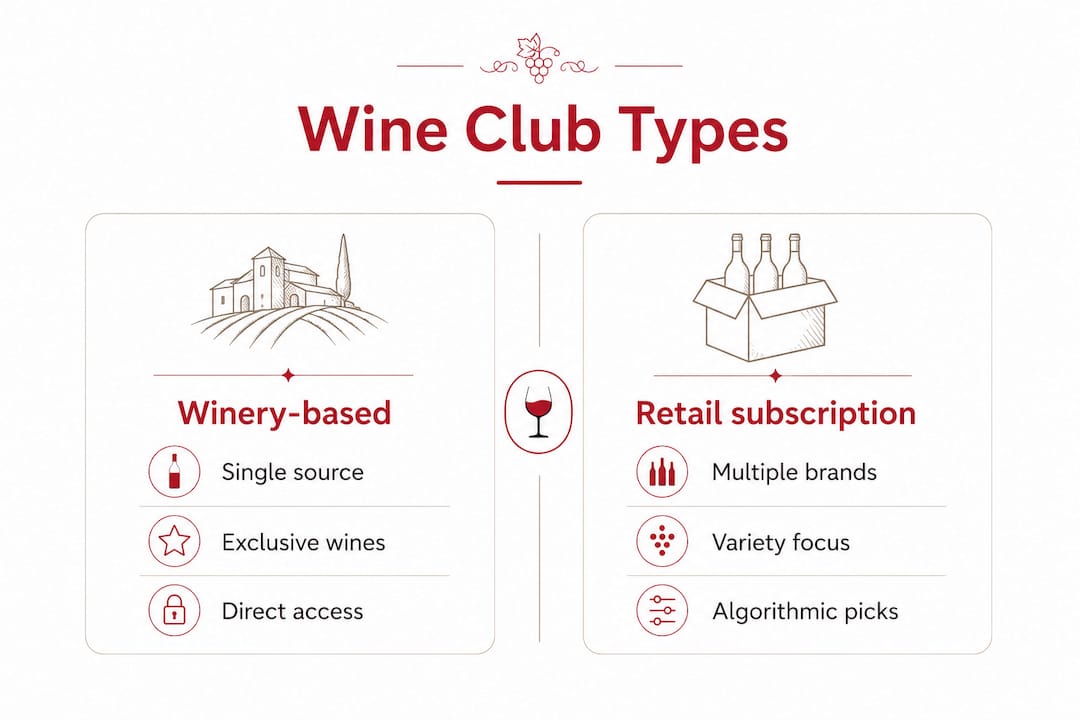
Winery-based clubs deliver a direct connection to a specific producer. You receive small-lot and library wines that never reach store shelves. The provenance is clear because you know exactly where every bottle was grown and made. That transparency adds real educational value. When you taste a Sonoma Coast Pinot Noir from the same estate three years in a row, you start to understand how vintage conditions shape a wine.
Retail-style subscriptions prioritize variety and convenience. Many commercial subscriptions rely on volume-based or algorithmic curation rather than human expert selection. That approach can expose you to a wide range of regions and grapes, which is great for beginners building a palate. The tradeoff is less consistency and weaker provenance. You may receive a Malbec from Argentina one month and a Grüner Veltliner from Austria the next, with little context connecting them.
True curation involves human selection rather than algorithmic assignment. Winery clubs with dedicated wine directors who taste and choose every shipment deliver a noticeably different experience than platforms that automate selections based on purchase history. If education and depth matter to you, a winery-based club wins. If variety and discovery are your goals, a retail subscription fits better.
How to organize a wine club at home
Organizing a wine club at home is one of the most rewarding ways to learn about wine without spending a fortune. The format is simple: a small group of friends meets regularly, tastes wines around a theme, and shares opinions. No sommelier certification required.
Follow these steps to get a home club running well from the start:
- Set your group size. Optimal home clubs have 6–10 members. Groups under six struggle to split costs effectively. Groups over twelve become too noisy for focused tasting and discussion.
- Meet monthly. Monthly meetings keep the group engaged without burning anyone out. Quarterly is too infrequent to build real momentum and shared knowledge.
- Rotate the host role. Sharing hosting responsibilities prevents one person from carrying the entire logistical burden. When everyone takes a turn, the group lasts longer and stays more invested.
- Pick a theme for each session. A tasting theme guides the educational focus while keeping the atmosphere relaxed. Try “Burgundy vs. California Pinot Noir” or “Old World vs. New World Cabernet.” Themes give members something to compare and discuss without requiring formal wine knowledge.
- Try blind tasting. Covering the labels removes bias and produces more honest opinions. Members often surprise themselves when their favorite bottle turns out to be the least expensive one.
- Partner with a local wine shop. Some home clubs collaborate with local shops or bars for venue space or purchasing guidance. A shop may offer a private tasting room during off-peak hours in exchange for your group’s regular business. That arrangement benefits everyone.
Pro Tip: Keep a shared tasting journal or group spreadsheet to track every wine you taste together. Over time, it becomes a record of your collective palate and a great reference for future purchases. Fine-wine-world has a helpful guide on starting a wine journal if you want a structured approach.
Benefits of joining a wine club for wine lovers and beginners
Joining a wine club delivers advantages that go well beyond getting bottles in the mail. The real value is in what those bottles teach you and the community they connect you to.
- Access to exclusive wines. Membership frequently includes invitations to exclusive events, access to library wines, and small-production bottles that never reach retail shelves. These are wines you simply cannot buy elsewhere.
- Curated discovery. A good club removes the paralysis of standing in a wine aisle with 300 options. Someone who knows wine deeply has already made the selection for you, based on quality and value.
- Cost savings. Standard discounts of 10%–20% on additional purchases add up quickly if you buy wine regularly. Combined with flat-rate shipping, the savings can offset the membership cost entirely.
- Education through repetition. Tasting wines from the same producer or region over multiple shipments builds pattern recognition. You start to notice how oak aging affects texture, or how a cooler vintage changes a wine’s acidity. That kind of learning sticks.
- Community and events. Many winery clubs invite members to harvest events, barrel tastings, and winemaker dinners. These experiences connect you to the people and places behind the wine in a way no book or podcast can replicate.
Beginners benefit especially from the guided structure. Instead of guessing which bottle to try next, you receive expert selections with context. Fine-wine-world’s guide to wines for beginners pairs well with any club membership, giving you a vocabulary to describe what you’re tasting.
Key Takeaways
A wine club is a recurring subscription that delivers curated wine shipments with exclusive access, member discounts, and educational value that grows with every bottle you taste.
| Point | Details |
|---|---|
| Core definition | A wine club sends curated wine shipments on a recurring schedule, typically monthly or quarterly. |
| Membership commitments | Most clubs require 2–4 minimum shipments before cancellation is permitted. |
| Winery vs. retail clubs | Winery clubs offer provenance and depth; retail subscriptions offer variety and convenience. |
| Home club success | Groups of 6–10 members meeting monthly with rotating hosts sustain the longest. |
| Key membership benefits | Members receive discounts, exclusive wines, shipping perks, and invitations to special events. |
Why the club you choose matters more than you think
I’ve tasted through dozens of wine club shipments over the years, and the single biggest mistake I see people make is joining a club based on price alone. A $30-per-month subscription sounds like a deal until you realize the wines are algorithmically selected, the provenance is vague, and the bottles are the same ones sitting on the discount shelf at your local grocery store.
The clubs that genuinely changed how I think about wine were winery-direct memberships. Receiving three vintages of the same Zinfandel from a small Dry Creek Valley producer taught me more about how weather shapes flavor than any textbook ever did. That kind of depth is hard to replicate with a variety-focused subscription.
My honest advice: if you’re a beginner, start with a retail-style subscription for six months to build broad exposure. Then graduate to a winery-based club once you know which regions and grape varieties excite you. And if you want community alongside the bottles, organize a home club with friends. The combination of a good subscription and a monthly tasting group is the fastest path to genuine wine confidence I know.
Watch the fine print on automatic billing. Winery-direct clubs mandate recurring payments and minimum shipment commitments that are easy to miss in the terms. Set a calendar reminder to review your membership every six months so you’re never paying for wine you don’t want.
— Adriana
Fine-wine-world’s resources for wine club members
Ready to find a club that fits your taste and lifestyle? Fine-wine-world has done the research so you don’t have to.
The wine clubs guide on Fine-wine-world covers curated recommendations across winery-based and retail-style memberships, with honest breakdowns of what each club delivers. Pair that with the beginner’s guide to wine regions to understand where your club’s bottles come from and why that matters. Whether you’re picking your first membership or rethinking a club that no longer excites you, Fine-wine-world gives you the context to choose with confidence.
FAQ
What is a wine club in simple terms?
A wine club is a subscription service that sends you a curated selection of wine bottles on a regular schedule, usually monthly or quarterly, often with member discounts and exclusive access to limited wines.
How do wine clubs typically work?
You sign up, choose your preferences, and the club charges your card automatically each shipment cycle. Most clubs require a minimum of 2–4 shipments before you can cancel.
What is the difference between a wine club and a wine subscription?
A wine club, especially a winery-based one, offers direct producer access, provenance guarantees, and human-curated selections. A wine subscription service often uses algorithmic curation and prioritizes variety over depth.
How do I organize a wine club at home?
Gather 6–10 friends, meet monthly, pick a theme for each tasting, and rotate the hosting role. Sharing logistics keeps the group sustainable and prevents any one person from burning out.
Are wine clubs worth it for beginners?
Yes. Wine clubs remove the guesswork of choosing bottles and provide curated discovery with tasting notes and context. Beginners build palate awareness faster through consistent, guided exposure than through random purchases.