
How to Remember Wine Names Easily in 2026
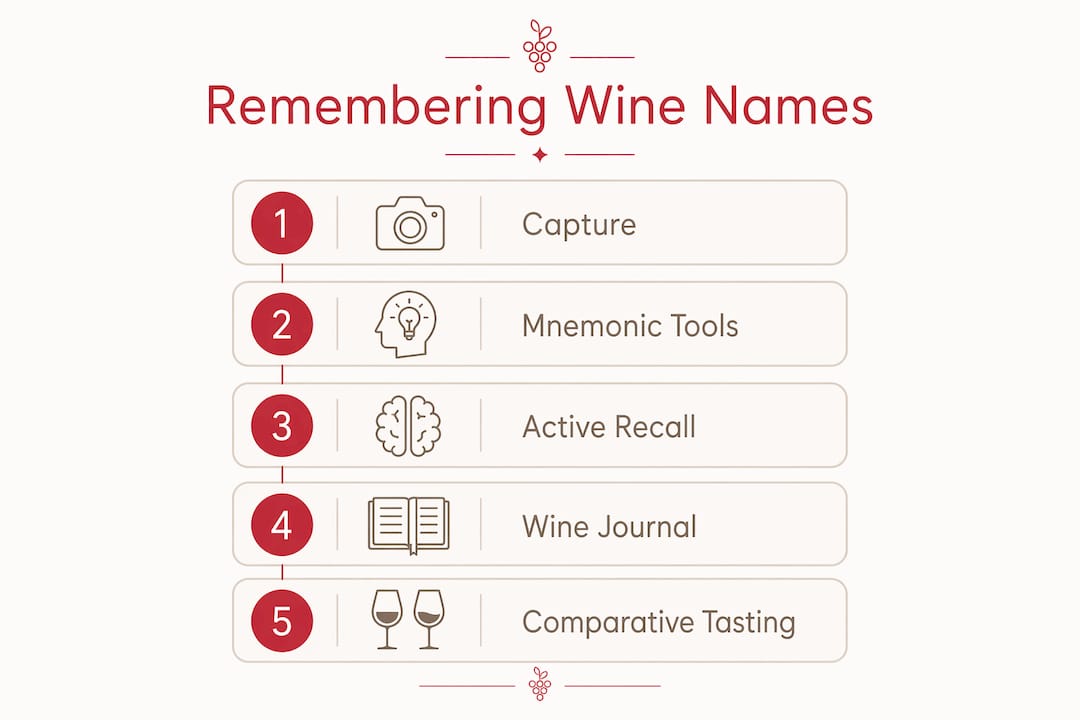
Remembering wine names easily comes down to three things: capturing details before your memory fades, using proven memory techniques to make names stick, and reviewing what you’ve learned on a schedule. You don’t need a sommelier’s credentials. You need a simple system and a little consistency.
Affiliate Disclosure: Some links on Fine Wine World are affiliate links, meaning we may earn a paid commission if you click through and make a purchase — at no extra cost to you. Affiliate programs use cookies to track commissions, which may collect personal data. You can read more about how we handle your data in our Privacy Policy and Affiliate Disclosure. We only recommend products we genuinely trust.
The fastest strategies to remember wine names easily
Start here. These are the techniques that work right away, no special equipment required.
- Snap the label immediately. Memory fades quickly after you set down the bottle. A photo takes five seconds and gives you a permanent visual record.
- Use spaced repetition. Reviewing wine names just before you’d naturally forget them cuts study time dramatically while locking in long-term recall. Apps like Anki automate the scheduling.
- Build a mnemonic. Acronyms, rhymes, and visual images give your brain a hook. “MERLOT, CAB, PINOT” sung as a phrase sticks far better than a plain list.
- Practice active recall. Active recall outperforms passive review by a wide margin. Close your notes and try to name the wine from memory before you look it up.
- Limit new names per session. Experts recommend no more than five new names per day to avoid overload and ensure deeper encoding.
- Tell a story. Link the wine to a moment. “The Burgundy we opened the night my sister got engaged” is unforgettable in a way that “Gevrey-Chambertin 2018” alone is not.
Why documenting wines right away changes everything
The window for capturing wine details is shorter than most people expect. Wine education platforms consistently recommend recording the name, vintage, your rating, and whether you’d buy it again as the four non-negotiable fields. Everything else is a bonus.
A photo of the front and back label is the minimum viable capture. Voice notes add texture without slowing you down. Dedicated apps like Sommo let you scan a label, rate the wine, and add a quick note in under 90 seconds. The back label often carries more useful information than the front, so don’t skip it.
Spaced repetition turns those captured notes into lasting memory. The method, formalized through research by Hermann Ebbinghaus on the forgetting curve, schedules reviews just before recall would slip. The Sommelier Education Authority recommends starting with 20 grape-region-style links on index cards or in Anki, drilling them on day 1, revisiting missed cards on day 3, and expanding the deck weekly. After three months of 15 minutes a day, 300 cards is realistic.
Pro Tip: Try to recall your previous tasting note before you re-taste a familiar wine. That retrieval attempt strengthens memory more than any amount of rereading.
How mnemonic devices and active recall make wine names stick
Mnemonics work because your brain prioritizes unusual, emotional, or patterned information over plain facts. For common varietals, a phrase like “MERLOT, CAB, PINOT, don’t forget the CHARD” gives you Merlot, Cabernet Sauvignon, Pinot Noir, and Chardonnay in a rhythm that’s easy to repeat aloud. Rhymes work the same way: the sillier or more vivid, the better.
J. Waugh Education recommends anchoring new wine names to things you already know. Link soil types to textures you’ve touched. Tie a wine region to a person you know. Match a grape synonym to a character or celebrity. These anchors give your brain somewhere to hang the new information instead of leaving it floating.
Active recall is the other half. Self-testing produces stronger retention than rereading or highlighting. Close your notes, try to name the wine from memory, then check. Teaching a wine to someone else who knows nothing about it forces the same retrieval process and compounds the benefit.
- Keep sessions short: five new names per day, no more.
- Combine methods: pair an acronym with a visual image of the label.
- Say names aloud. Verbal repetition adds an auditory layer to the memory.
How a wine journal reveals patterns and builds lasting recall
A wine journal does something a stack of tasting notes cannot: it makes patterns visible over time. After 50 entries, you’ll know whether you consistently love high-acid whites, whether high-tannin reds reward you or wear you out, and which producers keep showing up in your favorites. That kind of self-knowledge deepens recall because each new wine connects to a web of preferences you already understand.
The five fields that matter, according to Sommy Wine Coach, are: date and context, identity (grape, region, vintage), structure on a 1–5 scale, three honest descriptors in plain language, and a gut score with one sentence of why. Two minutes per entry. The weekly 15-minute review is what turns the journal from storage into learning.
Plain language descriptions outperform elaborate tasting prose for memory. “Tastes like strawberry and a little like wet stone” is more useful six months later than “elegant with hints of forest floor.” Write the way you’d describe the wine to a friend, then stop.
Paper journals are slower and more reflective. Digital apps are searchable and filterable, which matters once you have dozens of entries. Either works. The habit matters more than the format.
How comparative tasting trains your sensory memory
Sensory memory is a trainable skill, not a fixed ability. Focused aroma exposure and comparative tasting improve recognition and naming of wine characteristics in ways that passive drinking never does. The key is deliberate practice.
Pour two wines from the same grape but different regions. Smell, sip, and write down three differences. Willamette Valley Pinot Noir is brighter and more red-fruited than Russian River Pinot Noir. That relationship is easier to remember than either wine in isolation. Sommy Wine Coach’s six-drill framework, which includes daily five-minute reviews, two-wine comparisons, and blind reveals, produces measurable gains within four to eight weeks of consistent practice.
Blind tasting accelerates everything. Being wrong on a blind guess strengthens your memory library faster than always tasting with the label visible. Even one blind pour per week makes a real difference. Successful sommeliers build mental narratives linking aromas, regions, and styles rather than memorizing isolated facts. Pull one thread and the whole story comes with it.
Beginner-friendly wine knowledge that supports your memory
Understanding how wine is organized makes every memory technique more effective. When you know that Burgundy uses a five-tier classification from Regional AOC up to Grand Cru, a name like “Gevrey-Chambertin Premier Cru” carries meaning instead of sounding like noise. That context is what lets mnemonic links and spaced repetition actually stick.
Reading a wine label is a practical skill worth building early. The label tells you the producer, the region, the grape or appellation, and the vintage. Fine-wine-world’s guide to reading a wine label walks through exactly what each element means, which makes documentation faster and more accurate. The wine regions guide on Fine-wine-world adds the geographic layer that turns a name into a place you can picture.
Pairing wine with food deepens engagement and creates another memory anchor. The dinner, the dish, and the wine become one memory. That kind of emotional context, as research on wine and emotional connection confirms, anchors recall better than technical descriptors alone.
How visual cues and label designs help you recall wine names
Labels are memory tools hiding in plain sight. A distinctive illustration, an unusual color palette, or a striking animal on the label gives your brain a visual hook that the name alone doesn’t provide. When you see that label again in a store, recognition fires before you’ve even read the text.
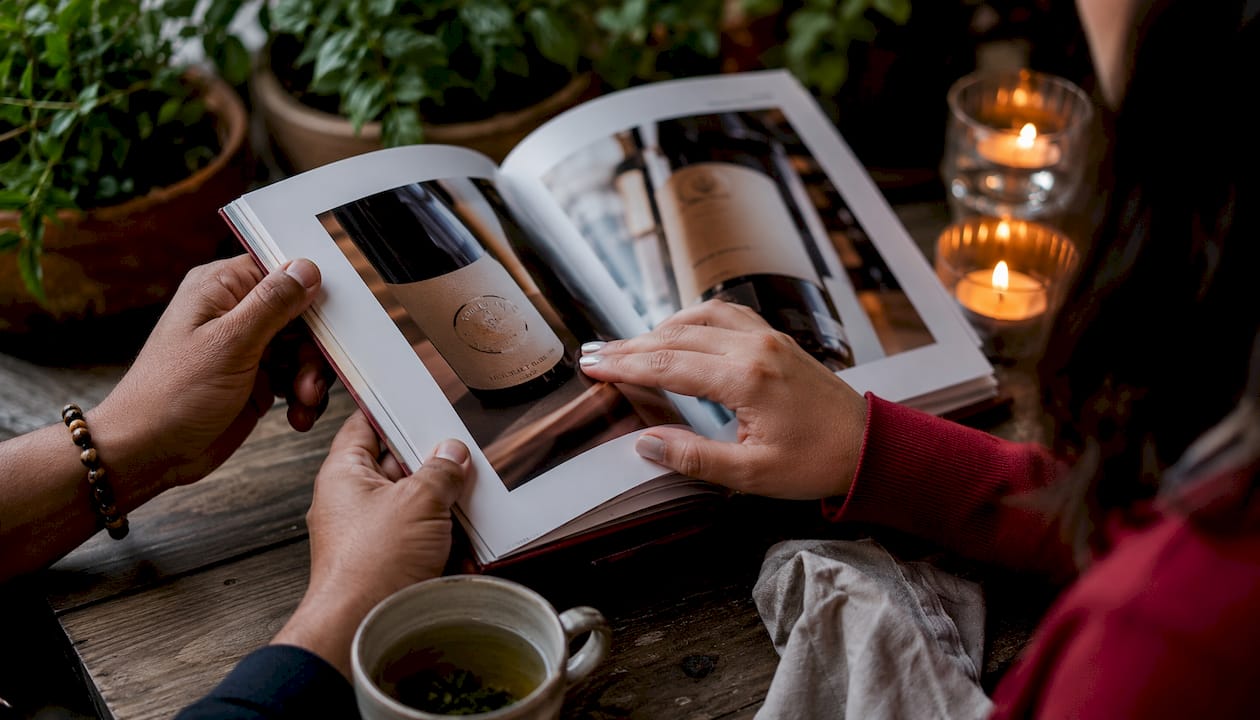
Build a dedicated photo album on your phone organized by grape or region. Scrolling through it before a dinner or a wine shop visit primes your memory. Some wine lovers print labels and stick them in a notebook, writing the date and a quick impression directly on the label. That physical act of handling and annotating creates a tactile memory layer on top of the visual one.
Connect the label’s imagery to the wine’s character. A label featuring a coastal scene for a crisp Albariño from Galicia gives you a story: ocean air, salt, bright acidity. That narrative association, recommended by the Sommelier Education Authority, creates a causal chain rather than an isolated data point.
Which digital tools actually help you memorize wine names
The right app removes friction from the moment of capture. Sommo scans labels automatically, prompts you for a rating and a quick note, and stores everything in a searchable history. Anki and Quizlet handle spaced repetition for grape-region-style facts, automatically scheduling cards based on your performance. Digital tools with label scanning and note-taking features consistently improve structured tracking and memory retention compared to unstructured note-taking.
For sensory training, no app replaces real wine and real aromas. Use digital tools for the vocabulary scaffold: grape-region pairings, appellation rules, classic style profiles. Use actual bottles and aroma samples for the sensory half. The combination is what Sommy Wine Coach calls the three-pillar approach: sensory anchoring, spaced repetition, and narrative association working together.
A wine tasting journal on Fine-wine-world gives you a practical starting point if you’re not sure which format fits your habits. Start simple. A photo album beats nothing. Add structure as the habit takes hold.
Key Takeaways
Remembering wine names consistently requires immediate capture, deliberate practice, and regular review working together as a system.
| Point | Details |
|---|---|
| Document immediately | Snap the label immediately; add a rating and one sentence before details fade. |
| Use spaced repetition | Review grape-region links on a schedule (day 1, day 3) using Anki or index cards. |
| Apply mnemonic devices | Acronyms, rhymes, and visual label associations give your brain a hook that plain lists don’t. |
| Keep a structured journal | Five fields per entry, plain language, and a weekly 15-minute review reveal preference patterns over time. |
| Train sensory memory | Two-wine comparisons and blind tasting drills produce measurable gains within four to eight weeks. |