

Wine sulfites (sulfur dioxide, or SO2) are safe for the vast majority of people. Winemakers add them to preserve freshness, prevent oxidation, and stop unwanted bacteria from spoiling the wine. A small minority, estimated at around 1% of the general population and roughly 5% of people with asthma, can experience reactions ranging from mild respiratory irritation to hives. Under U.S. rules, any wine containing 10 ppm (parts per million) of SO2 or more must carry a “contains sulfites” statement on the label, so spotting them at the store is straightforward once you know what to look for.
Affiliate Disclosure: Some links on Fine Wine World are affiliate links, meaning we may earn a paid commission if you click through and make a purchase — at no extra cost to you. Affiliate programs use cookies to track commissions, which may collect personal data. You can read more about how we handle your data in our Privacy Policy and Affiliate Disclosure. We only recommend products we genuinely trust.
Table of Contents
- What are wine sulfites, exactly?
- Why do winemakers add sulfites to wine?
- Free vs. bound sulfites: why wine pH changes everything
- How much SO2 is actually in your glass?
- U.S. labeling rules you should know
- Who is actually at risk from sulfites in wine?
- Three common myths about wine sulfites, debunked
- Practical steps to reduce your sulfite exposure
- What the research actually says about sulfites and health
- A word from Fine-wine-world
- Sources
What are wine sulfites, exactly?
Sulfites are compounds that contain sulfur dioxide (SO2), a naturally occurring gas produced when yeast ferment grape sugars into alcohol. Every wine contains at least some sulfites, even bottles with no added SO2, because fermentation generates them automatically. Winemakers then typically add more SO2 at various stages to protect the wine.
SO2 is not unique to wine. It shows up across the food supply, often at concentrations that exceed a typical glass of wine. The Cleveland Clinic notes that common dietary sources include:
- Dried fruits (apricots, raisins, prunes)
- Pickled vegetables and relishes
- Processed potato products (chips, instant mashed potatoes)
- Some bottled lemon and lime juices
- Certain processed sauces, gravies, and condiments
- Maraschino cherries and some jams
A handful of dried apricots can contain more sulfites than a full glass of wine. Keeping that in mind helps put the wine conversation in perspective.
Why do winemakers add sulfites to wine?
Sulfites do three jobs that no other single additive handles as cleanly. According to the Virginia Tech enology module on sulfur dioxide, SO2 acts as an enzyme inhibitor, an antioxidant, and an antimicrobial agent.
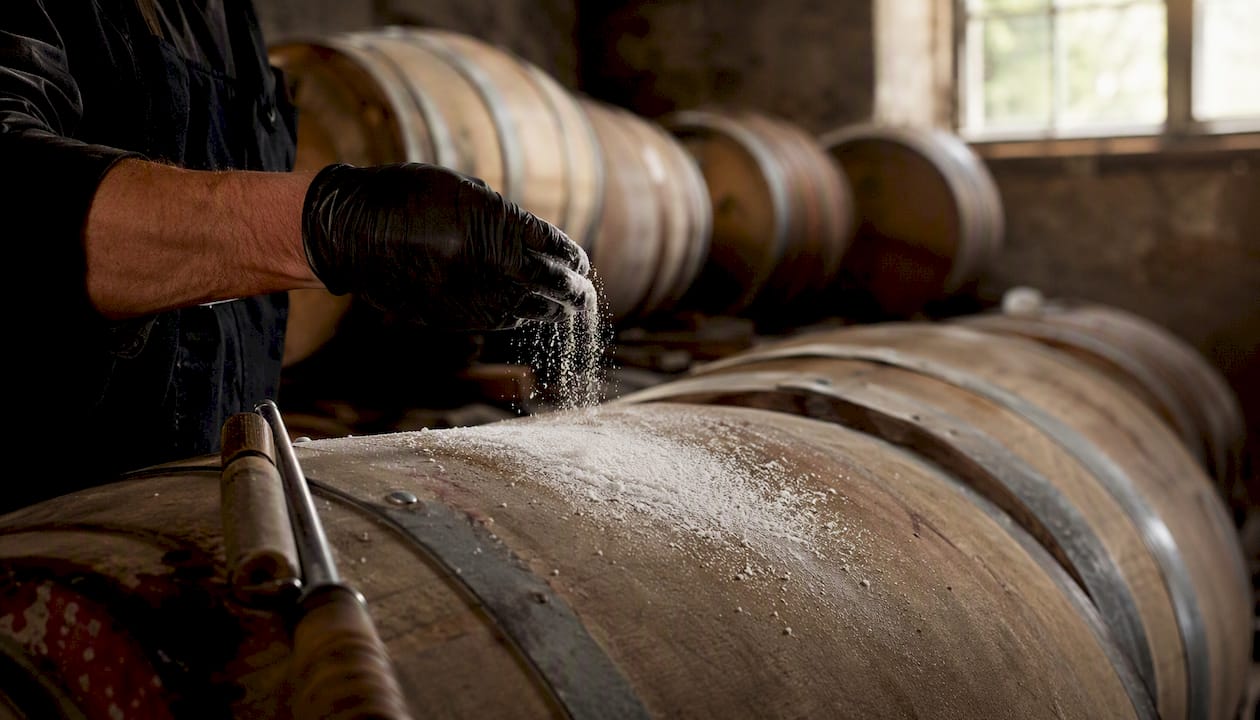
Enzyme inhibitor. Freshly crushed grapes contain oxidative enzymes that cause browning almost immediately, the same reaction you see when a cut apple turns brown. SO2 deactivates those enzymes before they can damage color and flavor.
Antioxidant. Oxygen is wine’s enemy during production and storage. SO2 competes with oxygen in the wine, slowing the chemical reactions that flatten aromas and turn a crisp white wine dull and sherry-like. This is why understanding wine oxidation matters so much for winemakers choosing their SO2 strategy.
Antimicrobial. Spoilage bacteria and wild yeasts can ruin a fermentation or cause off-flavors in a finished wine. SO2 suppresses those organisms, giving the winemaker’s chosen yeast strain a clean environment to work in.
Some winemakers deliberately minimize SO2 to let a wine express more raw, fermentation-driven aromatics. Natural and low-intervention wines often fall into this category. The tradeoff is real: less SO2 means shorter shelf life, greater sensitivity to temperature swings during shipping, and a higher risk of microbial instability once the bottle is open.
Pro Tip: If you love natural or low-SO2 wines, drink them young and keep them cold. They are not built for the back of a warm pantry shelf.
Free vs. bound sulfites: why wine pH changes everything
Not all the SO2 in a wine is doing protective work. The VT enology module explains that SO2 exists in wine in two main forms: free SO2 and bound SO2.
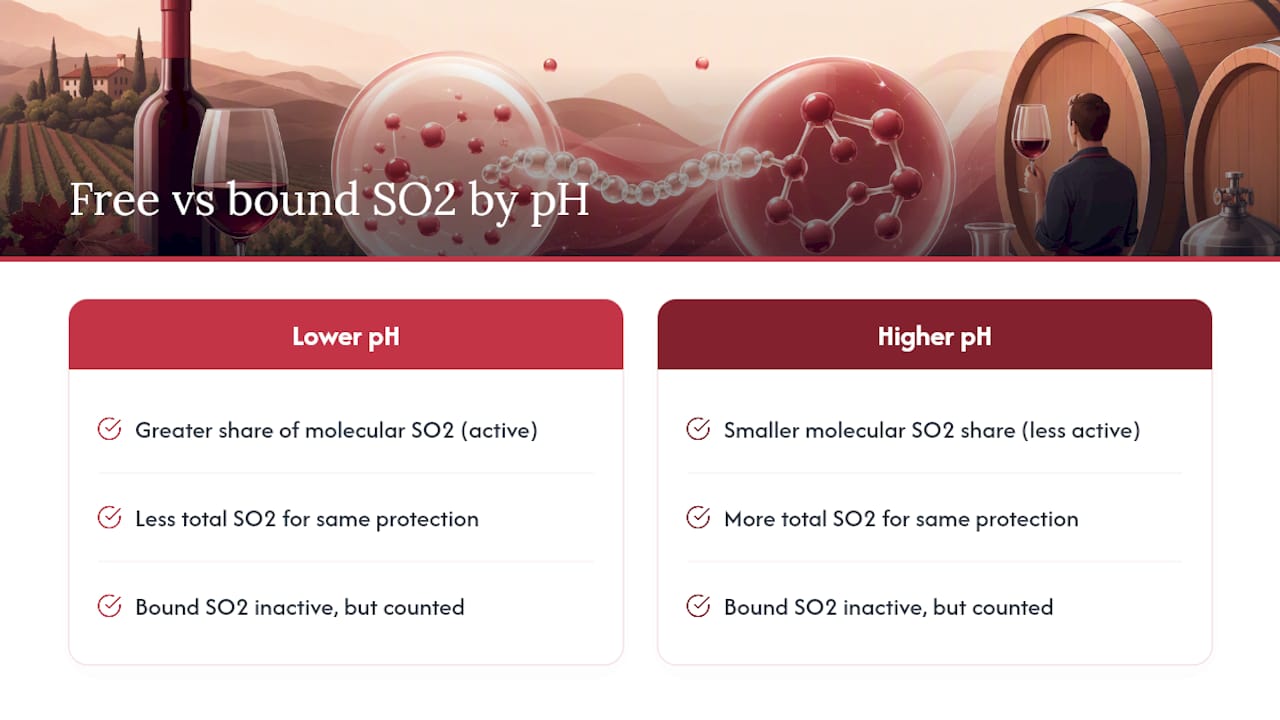
Free SO2 is the portion that has not reacted with other wine components. Within that free fraction, a small but critical slice exists as molecular SO2, the form that is genuinely active against microbes and oxidation.
Bound SO2 has combined chemically with compounds like acetaldehyde, sugars, and pigments. It is largely inactive from a preservation standpoint, even though it still counts toward the total SO2 on a lab report.
Here is where pH becomes the key variable. A lower pH (more acidic wine) pushes a greater share of free SO2 into the active molecular form. A higher pH does the opposite. The practical result is that a winemaker working with a high-pH wine needs significantly more total SO2 to achieve the same antimicrobial protection as a low-pH wine with less SO2 added.
Values are illustrative approximations based on standard enology equilibrium calculations.
This is why winemakers target free molecular SO2 levels rather than simply measuring total SO2. Total SO2 alone tells an incomplete story.
How much SO2 is actually in your glass?
The Waterhouse Lab at UC Davis reports that average total SO2 in wine runs around 80 mg/L, which works out to roughly 10 mg in a typical 5-ounce glass. That said, levels vary considerably by wine style.

Ranges are representative; actual levels vary by producer, vintage, and winemaking style.
Sweet wines sit at the high end because residual sugar feeds microbial activity, so more SO2 is needed to keep the wine stable. That is also why dessert wine pairings sometimes catch sensitive drinkers off guard.
Reading label claims correctly
Label language matters, and the terms are not interchangeable:
- “Contains sulfites” means the wine has 10 ppm or more of SO2. Required by U.S. law under TTB rules.
- “No sulfites added” means the winemaker did not add SO2. Natural fermentation sulfites may still be present, typically below 10 ppm.
- “No sulfites detected” requires lab analysis confirming SO2 below 1 mg/L. This is a stronger claim than “no added sulfites.”
- “Made with organic grapes” says nothing about added SO2. The grapes were grown organically, but SO2 may still have been added during winemaking.
- “Organic wine” (USDA certified) prohibits added sulfites entirely, though trace natural sulfites from fermentation may still be present.
U.S. labeling rules you should know
The U.S. framework for sulfite labeling involves the Alcohol and Tobacco Tax and Trade Bureau (TTB) for wine labels and the FDA for food safety standards. The core rule is simple: any wine sold in the United States with 10 ppm or more of SO2 must state “contains sulfites” on the label.
Here is what you can and cannot conclude from common label claims:
- “Contains sulfites” tells you SO2 is present at 10 ppm or above. It does not tell you how much.
- “No sulfites added” does not mean sulfite-free. Fermentation naturally produces SO2, and that residual amount may still affect sensitive individuals.
- “Organic” (USDA certified) prohibits added SO2 under the National Organic Program, but trace fermentation-derived sulfites are still possible.
- “Made with organic grapes” allows added SO2 up to 100 ppm for red wine and 150 ppm for white and rosé under USDA rules, so this label is not a low-sulfite guarantee.
- A wine with no label claim at all may simply contain less than 10 ppm, or the producer may have omitted the statement in error. When in doubt, contact the producer.
Who is actually at risk from sulfites in wine?
Most people drink wine with sulfites without any problem. The medical picture is nuanced, though. A review published in PMC distinguishes between two types of reactions: IgE-mediated allergy (a true immune response, rare) and non-immunologic intolerance or pseudoallergy (more common, but still uncommon overall).
People with asthma are the group most consistently identified in the clinical literature as being at elevated risk. Sulfites can trigger bronchospasm in some asthmatic patients, likely because inhaled SO2 from the wine irritates the airways. The Cleveland Clinic advises that anyone with asthma who notices respiratory symptoms after drinking wine should speak with a healthcare provider before continuing.
Common reported symptoms of sulfite sensitivity include:
- Wheezing or shortness of breath
- Hives or skin flushing
- Stomach cramps or nausea
- Runny nose or nasal congestion
- In rare cases, anaphylaxis (severe allergic reaction)
The EUFIC review notes that sulfites are generally regarded as safe for the general population, and regulatory bodies including EFSA do not raise long-term health concerns for most consumers. For a broader look at how wine compounds interact with health, the wine and health research summary on Fine-wine-world covers the wider picture.
Pro Tip: Before you cut out wine entirely, check whether dried apricots, pickles, or deli meats also bother you. Sulfites are concentrated in those foods too. If only wine triggers symptoms, something other than sulfites is likely the culprit. An allergist can run a proper challenge test.
Three common myths about wine sulfites, debunked
Myth 1: Sulfites cause wine headaches.
This is the most persistent misconception in wine culture, and the evidence does not support it. Harvard Health commentary points to alcohol volume, histamines, tyramine, and tannins as far more plausible headache triggers. The Waterhouse Lab at UC Davis notes that the medical literature contains virtually no reports clearly linking sulfites to headaches. If wine headaches are a recurring problem for you, the wine hangover guide on Fine-wine-world walks through the real causes and what actually helps.
Myth 2: Red wine contains more sulfites than white wine.
The opposite is generally true. Dry red wines typically contain less total SO2 than dry whites or sweet wines. Red wines have natural tannins and phenolic compounds that provide some antioxidant protection, reducing the amount of SO2 needed. White wines lack those compounds and need more SO2 to stay fresh.
Myth 3: Organic wine is sulfite-free.
Not necessarily. USDA-certified organic wine prohibits added sulfites, but naturally occurring fermentation sulfites can still be present. “Made with organic grapes” wines are allowed to contain added SO2. Always check the label rather than assuming organic means no sulfites.
Practical steps to reduce your sulfite exposure
If you have confirmed sensitivity or simply want to minimize SO2 intake, these steps give you real control.
- Read the label. Look for “no sulfites added,” “no sulfites detected,” or USDA certified organic wine. These are the clearest low-sulfite signals available at retail.
- Choose dry red wine when possible. Dry reds generally sit at the lower end of the SO2 range. Avoid sweet wines, which consistently carry the highest levels.
- Buy from small producers or natural wine shops. Many small-production winemakers use minimal SO2 by philosophy. Ask the staff directly.
- Check for certified organic or biodynamic labels. USDA organic certification prohibits added sulfites. Demeter-certified biodynamic wines also tend to use very low SO2.
- Avoid wines that have traveled long distances in warm conditions. Producers shipping to distant markets often add more SO2 to protect the wine in transit.
- Cross-check with other sulfite-rich foods. If dried fruit, pickles, or processed meats also bother you, sulfite sensitivity is a real possibility worth discussing with a clinician. If only wine triggers symptoms, look at other compounds. For guidance on food sensitivity testing, the evidence-based overview at FoodConnection is a useful starting point.
A note on decanting: decanting does allow some volatile free SO2 to dissipate into the air, but bound SO2 stays locked in the wine. Decanting is not a reliable method for removing sulfites, and it will not protect a sensitive person the way a genuinely low-SO2 wine will.
Pro Tip: When dining out, ask your server whether the restaurant carries any natural or low-intervention wines. Many restaurants now stock at least a few options, and the staff are usually happy to point you toward them.
What the research actually says about sulfites and health
The bottom line from the clinical and enology literature is this: sulfites are unlikely to cause headaches, they can trigger respiratory reactions in a subset of asthmatic patients, and true IgE-mediated sulfite allergy is rare.
The Waterhouse Lab is direct on headaches: average total SO2 in wine is around 80 mg/L, and the medical literature has virtually no reports clearly linking sulfites to headaches. The PMC review of allergic and intolerance reactions to wine confirms that intolerance reactions (non-IgE) are more common than true allergy, and that asthmatic patients represent the clearest at-risk group. The VT enology module provides the technical grounding for why SO2 levels and activity vary so much between wine styles, which helps explain why population-level safety data can coexist with individual sensitivity cases.
What the evidence is strong on: Sulfites can provoke asthma exacerbations in sensitive patients. The association is documented and clinically recognized. Sulfites are safe for the general population at typical dietary exposure levels.
What the evidence is weak on: A direct causal link between wine sulfites and headaches in people without asthma. Studies are limited, and confounders (alcohol, histamine, tyramine) are rarely controlled for.
What remains uncertain: The exact prevalence of non-asthmatic sulfite intolerance, the threshold dose that triggers reactions in sensitive individuals, and whether low-SO2 wines meaningfully reduce symptoms in self-reported sensitive drinkers who have not been clinically tested.
The EUFIC analysis adds useful context: EFSA has noted that some consumers may exceed the acceptable daily intake (ADI) from wine alone at the highest permitted SO2 levels, but does not currently flag long-term health concerns for the general population. Harvard Health reinforces the point that alcohol itself and other wine compounds are far more plausible headache triggers than SO2.
A word from Fine-wine-world
Wine is one of life’s genuine pleasures, and the sulfite conversation has caused a lot of unnecessary anxiety for everyday drinkers. The science is clearer than the headlines suggest: most people have nothing to worry about, and those who do have a real sensitivity have practical, evidence-based options available to them.
What strikes me most about this topic is how often the sulfite myth distracts people from the real culprits. If you are getting headaches after a glass of red wine, the alcohol, the histamines, or even just drinking on an empty stomach are far more likely explanations than the SO2 in the bottle. Understanding that distinction is genuinely freeing. It means you do not have to avoid wine entirely. You just need better information.
If you want to keep exploring the world of wine with confidence, the wine regions guide on Fine-wine-world is a great next step. And if aging and cellaring interest you, the guide to aging wine covers how sulfite strategy shapes a wine’s long-term potential.
Sources
These are the primary sources behind the claims in this article. Each one is worth bookmarking if you want to go deeper.
- Sulfites | Waterhouse Lab
- Allergic and intolerance reactions to wine – PMC
- Sulfur Dioxide (VT enology module)
- What are sulphites in wine and are they bad for you? | EUFIC
- Sulfite Sensitivity | Cleveland Clinic
- Ask the doctor: What causes red wine headaches | Harvard Health
- Why There Are Sulfites in Wine and How They Could Affect You | Healthline
This article is general information, not a substitute for advice from a qualified doctor. Consult a qualified healthcare professional about your own circumstances before acting on anything here.