
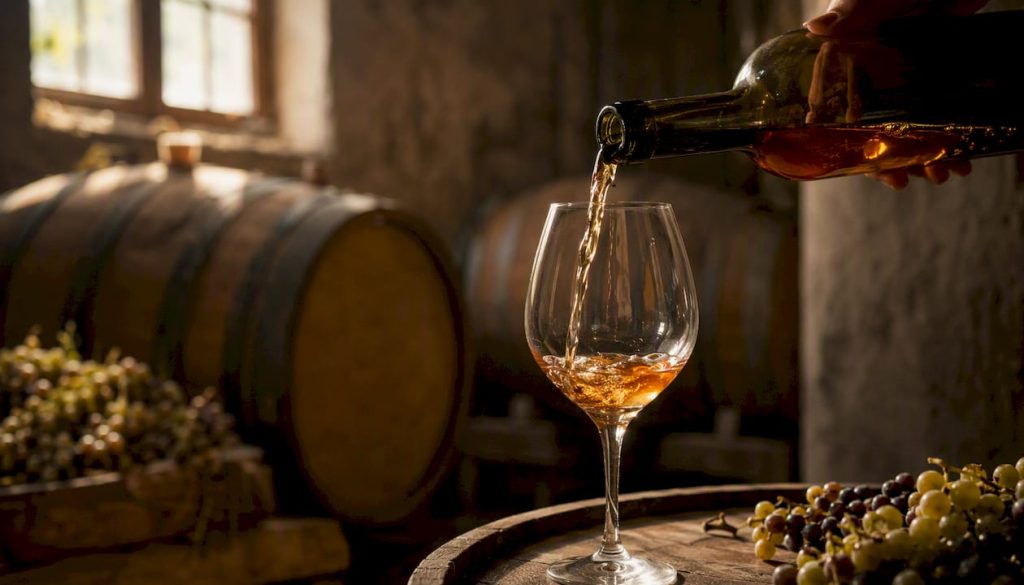
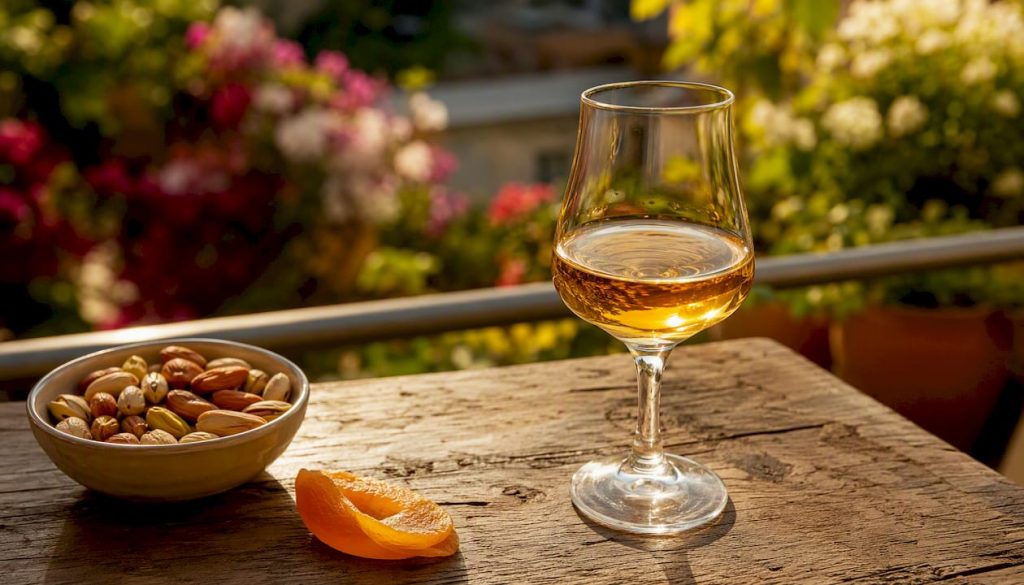
Orange wine is white grapes fermented with their skins left in contact with the juice, producing a wine that ranges in color from golden amber to deep copper. The name comes from that color, not from the fruit. As Cambridge Dictionary defines it, the grape skins stay in contact with the juice during production, extracting pigments, tannins, and phenolics that no standard white wine ever sees.
A few things worth knowing right away:
- Orange wine is also called skin-contact wine or amber wine — all three terms describe the same technique.
- It sits between white and red wine in texture: white wine’s brightness and acidity, with some of a red wine’s grip and body.
- That structure makes it surprisingly useful at the dinner table, especially with foods that trip up most whites and reds.
Affiliate Disclosure: Some links on Fine Wine World are affiliate links, meaning we may earn a paid commission if you click through and make a purchase — at no extra cost to you. Affiliate programs use cookies to track commissions, which may collect personal data. You can read more about how we handle your data in our Privacy Policy and Affiliate Disclosure. We only recommend products we genuinely trust.
Key Takeaways
Orange wine is white grapes fermented with skin contact, producing amber color, real tannin, and savory complexity that makes it one of the most food-friendly wine styles available.
| Point | Details |
|---|---|
| Core definition | White grapes fermented on their skins; also called skin-contact or amber wine. |
| Maceration range | Skin contact runs from 2–5 days (light style) up to 6 months (Kakhetian method). |
| Top pairing rule | Pair with spicy, umami-rich, or fatty dishes that overwhelm most whites and light reds. |
| Label tip | Look for “skin-contact,” “amber,” or “macerated” on the label to confirm the style. |
| Best starting point | Short-maceration Pinot Grigio or Ribolla Gialla from Friuli is the most approachable entry. |
Table of Contents
- What is orange wine, and how is it made?
- Where did orange wine come from?
- What does orange wine actually taste like?
- Which grapes and regions produce orange wine?
- How to pair orange wine and serve it well
- Why sommeliers and researchers call orange wine a “food wine”
- How to pick an orange wine in a shop or on a menu
- Common myths about orange wine worth clearing up
- My honest take on orange wine
- Sources
What is orange wine, and how is it made?
The process starts like any white wine: harvest, crush, and fermentation. The key difference is that the grape skins, seeds, and sometimes stems stay in contact with the juice throughout fermentation rather than being removed immediately after pressing. According to the Australian Wine Research Institute, this red-winemaking technique applied to white grapes produces greater extraction of phenolics and often noticeable tannin and savory complexity.
Here is how a typical batch moves from vineyard to bottle:
- Harvest and crush — grapes are picked and either destemmed or left as whole clusters.
- Maceration and fermentation on skins — juice and skins ferment together, often with wild (ambient) yeast. This is where color and texture develop.
- Pressing — skins are separated from the wine after the desired maceration time.
- Maturation — the wine rests in amphora (qvevri), steel tanks, or oak barrels before bottling. Sulfur additions vary widely; some producers use none.
Maceration length is the single biggest variable in the style. Wikipedia’s orange wine entry documents the range clearly:
| Maceration style | Typical duration | Color and texture result |
|---|---|---|
| Short skin contact | 2–5 days | Pale amber, light tannin |
| Medium maceration | 15–30 days (Imeretian) | Deeper gold, moderate grip |
| Long maceration | Up to several months (Kakhetian) | Deep amber/copper, firm tannin |
Pro Tip: On a label, look for the words “skin-contact,” “amber,” or “macerated.” A label that only says “cold soak” or “macération pelliculaire” describes a pre-fermentation technique that adds aroma but delivers far less tannin and color — it is not the same thing as true skin-fermented orange wine.
Where did orange wine come from?
The method is ancient. Georgia has been fermenting white grapes on their skins in buried clay vessels called qvevri for at least 8,000 years, making it one of the oldest documented winemaking traditions on earth. Two regional styles define Georgian practice:
- Kakhetian method — long maceration, sometimes up to six months in qvevri, producing deeply colored, tannic, oxidative wines.
- Imeretian method — shorter maceration, typically 15–30 days, with a lighter result.
The 20th century pushed these techniques to the margins as industrial winemaking favored clean, filtered whites. Then, the revival happened:
- 1990s–2000s: Friulian winemaker Josko Gravner and Slovenian producers like Stanko Radikon began fermenting white grapes on skins in amphora, deliberately reviving ancient methods.
- 2000s: The term “orange wine” was coined to describe the style, per VinePair’s guide, even though the technique itself predates the label by millennia.
- 2010s–2020s: Importers brought Georgian and Friulian bottles to the U.S. market; natural wine bars and restaurant sommeliers put them on lists.
- 2026: Orange wine appears on menus across the country, with global sales growing at a pace that reflects genuine mainstream curiosity.
What does orange wine actually taste like?
Expect something that smells and feels unlike any white you know. The color alone signals what is coming: golden to deep amber in the glass, sometimes slightly hazy if the wine is unfined.
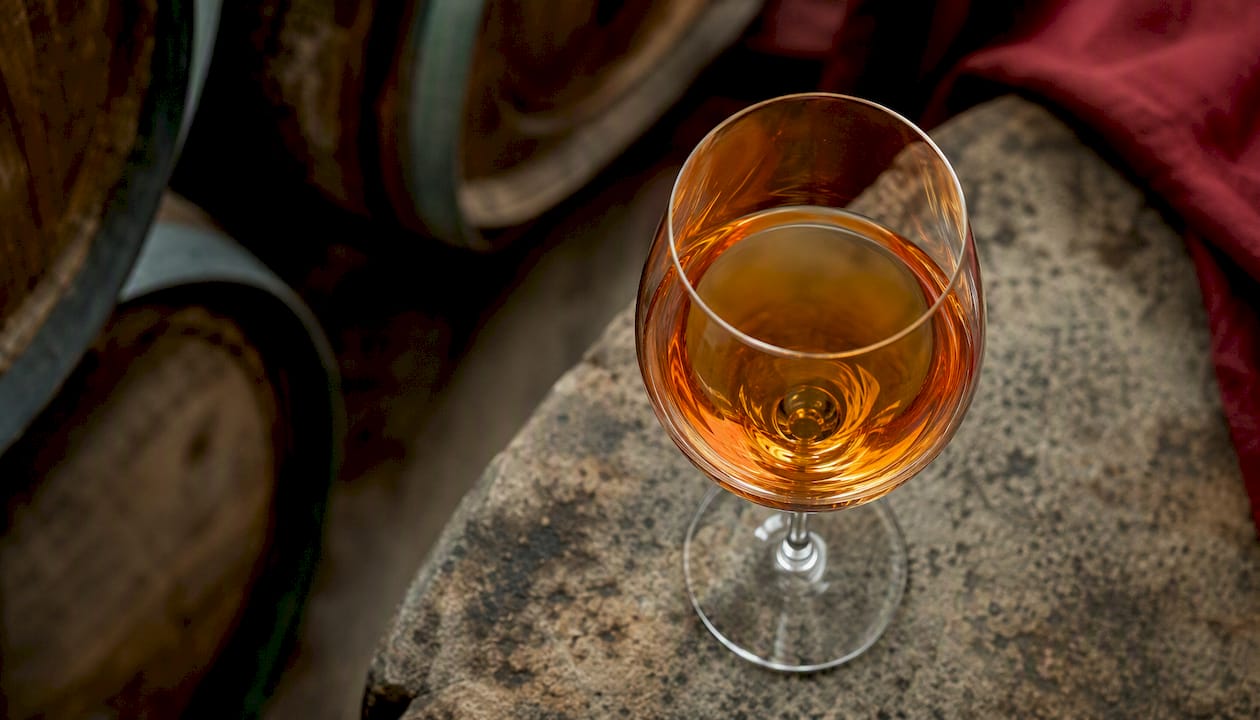
Common aromas include dried citrus peel, chamomile tea, bruised apple, apricot, walnut, and sometimes a savory, almost mushroomy note. Longer macerations add oxidative nuttiness, closer to dry sherry than to Chardonnay. The palate carries real texture — tannin you can feel on your gums — alongside the bright acidity typical of white grapes.
Two contrasting profiles give a sense of the range:
| Style | Color | Aromas | Tannin | Best comparison |
|---|---|---|---|---|
| Short maceration (fresh) | Pale gold-amber | Peach, citrus peel, floral | Low to medium | Textured Pinot Grigio |
| Long maceration (oxidative) | Deep copper | Walnut, dried apricot, tea, earth | Medium to firm | Dry amontillado sherry meets white Burgundy |
Filtration and sulfur choices shape the final texture. Unfined, unfiltered bottles can be cloudy and more variable bottle to bottle. Wines with moderate sulfur additions tend to be more consistent and approachable for first-time drinkers.
Which grapes and regions produce orange wine?
Almost any white grape can be made into a skin-contact wine, but some varieties take to the technique particularly well. Wine Spectator notes that the style is traditional in Georgia and now widespread from Italy to California.
| Grape | Classic region | U.S. availability |
|---|---|---|
| Rkatsiteli | Kakheti, Georgia | Specialty importers, Georgian wine shops |
| Kisi | Kakheti, Georgia | Niche importers, urban wine bars |
| Ribolla Gialla | Friuli-Venezia Giulia, Italy | Italian wine importers, fine wine shops |
| Pinot Grigio / Pinot Gris | Friuli, Slovenia, Alsace | Widely available; look for “skin-contact” on label |
| Gewürztraminer | Alsace, Austria | Specialty retailers |
| Vermentino | Sardinia, Tuscany | Italian wine sections, online retailers |
| Sauvignon Blanc | Slovenia, New Zealand, California | Growing U.S. production; check domestic producers |
For U.S. shoppers, the easiest entry points are skin-contact Pinot Grigio from Friuli or a domestic California or Oregon producer working with Pinot Gris or Sauvignon Blanc. Look for label terms like “skin-contact,” “amber,” or “macerated” alongside a region name. Importer tags from known Georgian or Friulian specialists are a reliable quality signal.
- Georgian bottles: seek importers specializing in Caucasus wines.
- Italian/Slovenian bottles: Friuli-Venezia Giulia and Brda (Slovenia) on the label are strong cues.
- Domestic U.S.: California and Oregon producers are increasingly releasing skin-contact whites worth exploring.
How to pair orange wine and serve it well
Orange wine’s combination of white wine acidity and red wine tannin makes it one of the most food-friendly styles you can pour. The Sensory Chef’s wine pairing guide captures this well: structured wines with savory complexity tend to anchor a wider range of dishes than either a light white or a full red.
Pairings that work particularly well:
- Spicy Asian cuisine — Thai, Szechuan, Korean BBQ; the tannin softens heat without clashing.
- Indian dishes — lentil curries, tandoori, spiced vegetables; the wine’s earthiness matches the spice.
- Grilled vegetables and mushrooms — umami-rich dishes that overwhelm most whites.
- Charcuterie and cured meats — the grip handles fat and salt beautifully; see Fine-wine-world’s charcuterie pairing guide for specifics.
- Richer seafood — grilled octopus, crab, lobster bisque; lighter macerations work best here.
- Strong cheeses — aged Gouda, Manchego, washed-rind styles.
Pro Tip: Serve orange wine slightly cooler than a red but warmer than a typical white — around 55–60°F. A wide-bowled white wine glass or a small red wine glass works better than a narrow flute, giving the aromas room to open. If your bottle is unfined and hazy, that cloudiness is normal; decanting for 20–30 minutes can help it open up.
Why sommeliers and researchers call orange wine a “food wine”
The AWRI’s amber wine resource explains the structural reason clearly: fermenting on skins, seeds, and sometimes stems extracts phenolics that add savory complexity and texture. The result bridges white wine’s acidity and red wine’s structure in a way that makes orange wine unusually versatile with difficult-to-match foods.
Key insight: Orange wine’s phenolic extraction gives it the grip to stand up to spice, umami, and fat — the three flavor forces that most whites and light reds struggle against.
That structural middle ground is exactly why you see it on restaurant lists alongside dishes that would overwhelm a Sauvignon Blanc and feel too heavy for a Pinot Noir.
How to pick an orange wine in a shop or on a menu
Shopping for skin-contact wine is easier once you know what to look for:
- Label terms: “skin-contact,” “amber,” “macerated,” or “skin-fermented” all signal the style. “Orange wine” itself is increasingly appearing on back labels.
- Maceration length clues: some producers note days or weeks of skin contact on the back label — longer generally means more tannin and color.
- Vessel notes: “qvevri,” “amphora,” or “clay vessel” on the label suggests a Georgian or Georgian-inspired approach with more oxidative character.
- Price range: entry-level bottles ($18–$28) tend to be shorter maceration, lighter, and more approachable. Mid-range ($30–$55) often reflects longer maceration or amphora aging. Above $55, you are typically in artisan or limited-production territory.
- Try by the glass first: ask your server for something “skin-contact” or “amber” — most wine bars have at least one option and staff can describe the style simply.
For deeper pairing experiments once you have a bottle in hand, Fine-wine-world’s food and wine pairing guide is a practical next step.
Common myths about orange wine worth clearing up
A few misunderstandings come up constantly, and they are worth addressing directly.
- It is not made from oranges. The name refers to color and technique, full stop. Wine Spectator and Decanter both flag this as the most common misconception.
- Orange does not mean natural. As Decanter’s expert explainer notes, “orange” describes a production technique, not a philosophy. Conventional producers use skin contact too; orange color alone does not mean the wine is low-intervention or additive-free. For a clear breakdown of where natural wine begins and ends, Fine-wine-world’s natural vs. organic wine guide covers the distinctions well.
- “Cold soak” is not the same thing. Pre-fermentation cold maceration (macération pelliculaire) adds aroma but delivers little tannin or oxidative character. True skin-fermented orange wine keeps skins present throughout fermentation.
- Hazy does not mean faulty. Many orange wines are unfined and unfiltered by design. Cloudiness is a style choice, not a sign of spoilage.
- Sulfite sensitivity note: some orange wines are made with little or no added sulfur, which can make them more variable and potentially more reactive for people with sulfite sensitivity. Always check the label or ask the retailer if this matters to you.
My honest take on orange wine
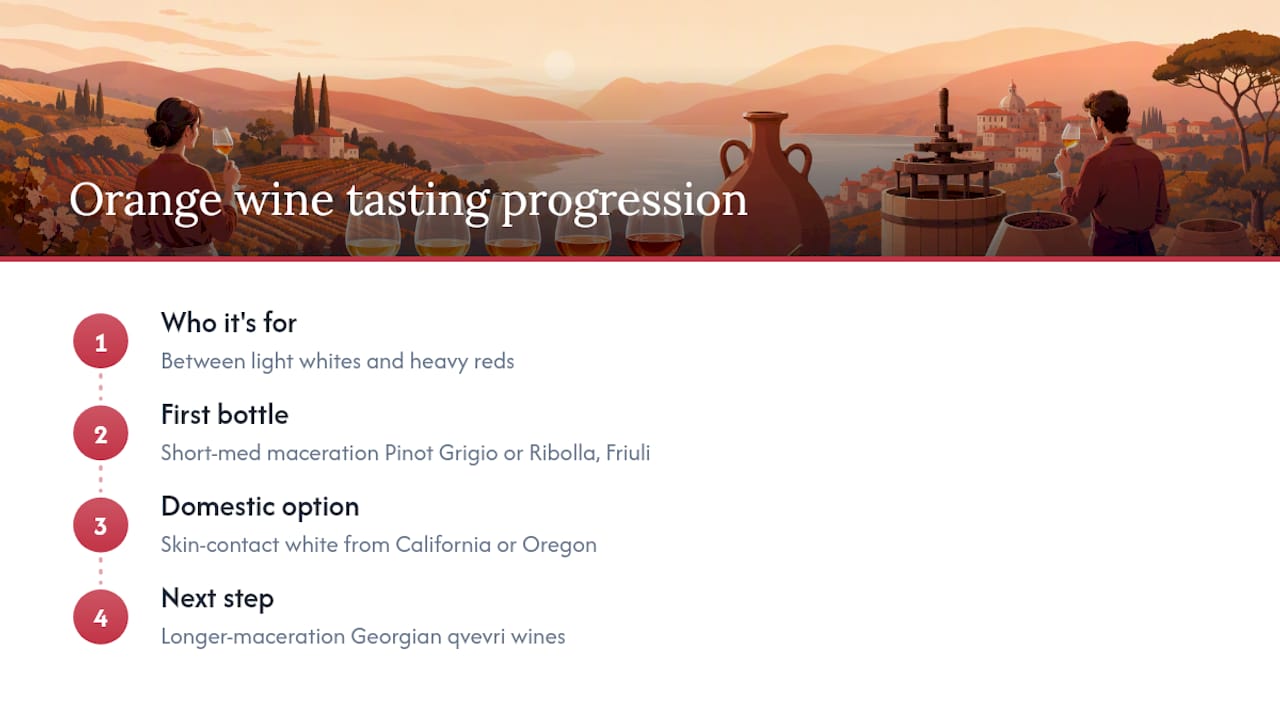
Orange wine is the style I recommend most often to wine drinkers who feel stuck between “white wine is too light” and “red wine is too heavy.” It genuinely occupies that middle ground, and not in a compromise way — in a way that opens up whole categories of food that most wines fumble.
My suggestion for a first bottle: look for a short-to-medium maceration Pinot Grigio or Ribolla Gialla from Friuli, or a domestic skin-contact white from California or Oregon. These tend to be approachable, not aggressively tannic, and a good introduction to what the style can do. Once you have tried one, the longer-maceration Georgian qvevri wines make a lot more sense as a next step.
If you want to explore the regions behind these wines, Fine-wine-world’s wine regions of the world guide is a good place to start mapping Georgia, Friuli, and Slovenia on your wine radar.
Sources
- Winemaking treatment – Amber wine – The Australian Wine Research Institute
- Orange wine – Wikipedia
- How is orange wine made? – Wine Spectator
- The Complete Guide to Orange Wine | VinePair
- The marvellous world of orange wines: Everything you wanted to know explained by an expert | Decanter