
What Are Corks Made Of: Natural Cork Explained
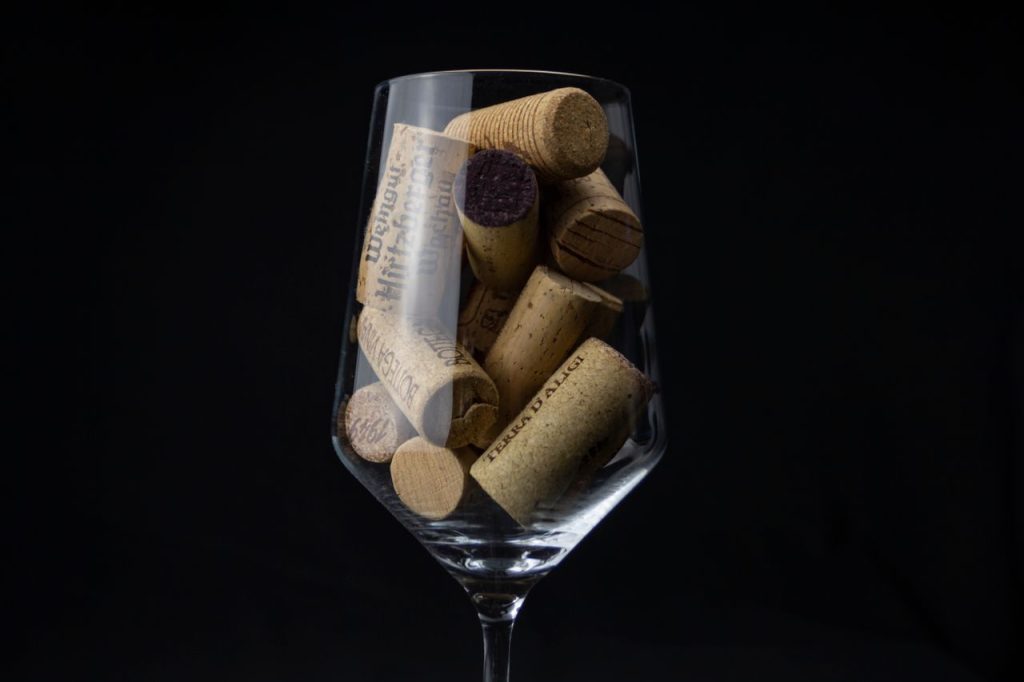
Natural wine corks are made from the bark of Quercus suber, the cork oak tree. That bark is a remarkable plant tissue built almost entirely from gas-filled cells, and its chemistry is what makes it work so well as a bottle stopper.
The main components at a glance:
- Suberin — the primary structural polymer; makes cork nearly impermeable to liquids
- Lignin — adds rigidity and mechanical strength to cell walls
- Cellulose and hemicellulose — provide elasticity and flexibility
- Extractables (waxes, tannins, salts) — minor compounds that influence surface chemistry
- Gas — the dominant “ingredient” by volume; roughly 85% of cork tissue is air, sealed inside millions of tiny cells
Most of the cork harvested worldwide ends up as bottle stoppers. About 68% of commercial cork production) goes toward wine closures, with the remainder used for flooring, insulation, and other products.
Affiliate Disclosure: Some links on Fine Wine World are affiliate links, meaning we may earn a paid commission if you click through and make a purchase — at no extra cost to you. Affiliate programs use cookies to track commissions, which may collect personal data. You can read more about how we handle your data in our Privacy Policy and Affiliate Disclosure. We only recommend products we genuinely trust.
Table of Contents
- What are corks made of at the cellular level?
- Where does cork come from, and is it sustainable?
- How is cork produced, step by step?
- What are the main types of wine corks?
- How does cork actually affect the wine inside the bottle?
- Is cork safe, and what does “corked” actually mean?
- Why cork still matters in the modern wine world
- Sources
What are corks made of at the cellular level?
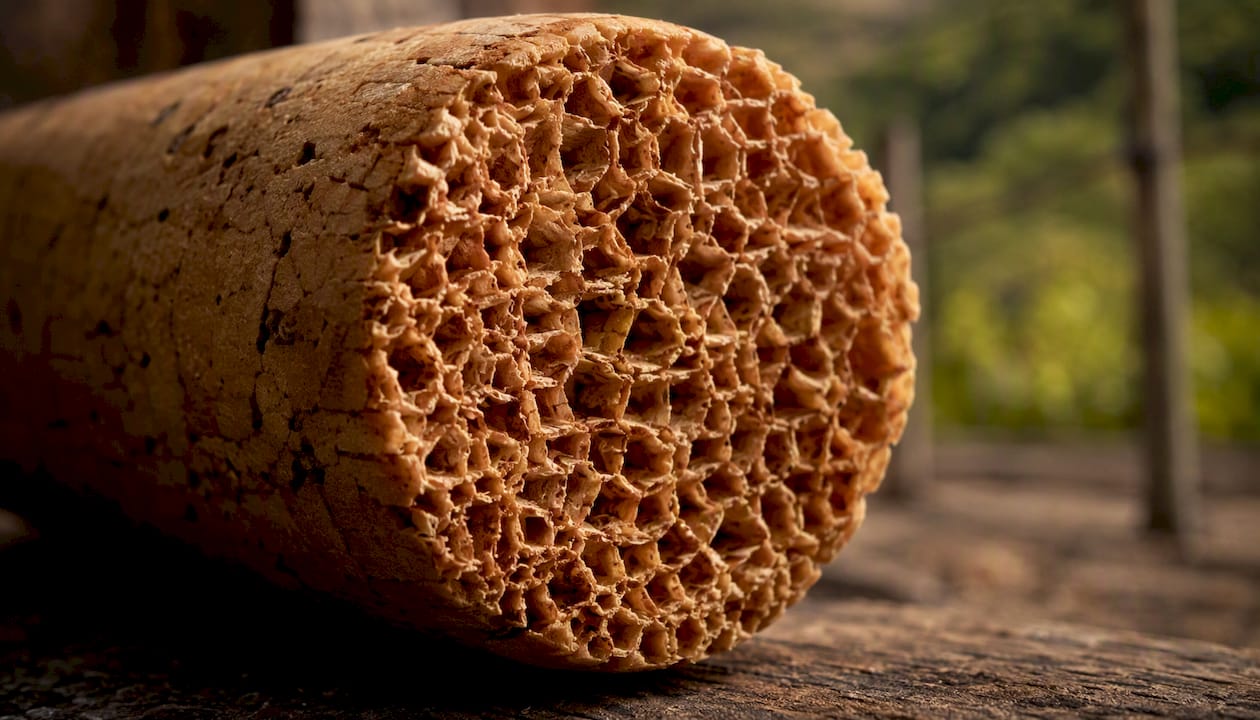
Cork’s behavior — springy, compressible, nearly liquid-proof — comes directly from its microscopic architecture. Botanical analyses from Harvard’s Arnold Arboretum describe the tissue as a honeycomb of polyhedral dead cells, each one sealed and filled with gas. The tissue is roughly 15% solid material and 85% air, which explains why a cork stopper is so light and why it bounces back after compression.
Each cubic centimeter of cork contains millions of these tiny air chambers. Think of it as natural bubble wrap: the gas pockets absorb shock, resist heat transfer, and prevent liquid from passing through. That combination is genuinely hard to replicate with synthetic materials.
Chemical composition and what each component does
The chemistry behind cork’s performance breaks down like this, based on CAMEO Chemicals / MFA analysis:
| Chemical component | Approximate % of dry weight | Functional role |
|---|---|---|
| Suberin | 35–60% | Waterproofing; primary barrier to liquid and gas |
| Cellulose / hemicellulose | 30–33% | Flexibility and elasticity of cell walls |
| Lignin | 27–32% | Structural rigidity; resists compression over time |
| Extractables (waxes, tannins, salts) | Small fraction | Surface chemistry; minor flavor/aroma interactions |
Suberin is the star of the show. It’s a fatty acid polymer that coats every cell wall, making each tiny chamber essentially waterproof. Lignin keeps the whole structure from collapsing under the pressure of a tight bottle neck. Cellulose and hemicellulose are what let the stopper spring back after you push it in.
The FAO’s technical document on cork and cork oak notes that this gas-filled cellular structure also gives cork its buoyancy and its well-known thermal and acoustic insulation properties — which is why you find it in everything from wine bottles to spacecraft heat shields.
Where does cork come from, and is it sustainable?
Cork comes from one species: Quercus suber, the cork oak. These trees grow primarily across the western Mediterranean, with Portugal and Spain together accounting for the majority of global production. Other significant growing regions include Algeria, Morocco, Tunisia, Italy, and France.
What makes cork genuinely sustainable is that the tree is never cut down. Harvesters strip the outer bark by hand using specialized axes, leaving the inner bark intact so the tree can regenerate. According to Amorim Cork, a cork oak is first harvested around age 25, then re-harvested roughly every nine years. Only after the third stripping, many years into the harvest cycle, does the bark reach the density and uniformity needed for high-quality natural wine stoppers. That third-harvest bark is called “amadia” cork.
Why cork forests are considered an environmental asset:
- Trees are not felled; stripping actually stimulates healthy bark regrowth
- Cork oak forests (montado in Portugal, dehesa in Spain) support exceptional biodiversity, including endangered species like the Iberian lynx
- The industry channels lower-grade bark and production offcuts into granulated products, creating a low-waste supply chain
- Cork forests sequester significant amounts of carbon, especially after each harvest when regrowth accelerates
Harvest timeline: First strip at ~25 years old. Re-harvest every 9 years. Stopper-grade “amadia” cork from the third harvest onward (~year 43).
How is cork produced, step by step?
The journey from tree bark to finished wine stopper is longer and more hands-on than most people expect. Industry producers describe a multi-stage process that spans multiple seasons and often years for premium stoppers.
Stripping the bark — Trained workers use long-handled axes to score and peel the outer bark in large planks. The technique requires skill: cut too deep and you damage the tree; too shallow and the plank tears. Each tree is stripped by hand, typically in late spring and early summer when the bark separates most cleanly.
Resting and seasoning — Freshly stripped planks are stacked outdoors for a minimum of six months, often longer. Quality producers store them on concrete or raised racks rather than bare earth to limit soil-borne microbial contamination that could later contribute to taint.
Boiling — Planks are submerged in large vats of boiling water. Corticeira Amorim, the world’s largest cork processing group, reports that boiling rehydrates the bark and can increase its volume by roughly 20%, making the planks more flexible and easier to punch. Boiling also cleans the surface and, in advanced industrial setups, helps remove volatile compounds that can cause off-flavors.
Drying and sorting — After boiling, planks dry for several weeks. Workers and machines sort them by thickness, flexibility, and visible surface quality, setting aside the best planks for natural stoppers.
Punching or drilling — Cylindrical stoppers are punched or drilled from the plank perpendicular to its surface, so the stopper’s cross-section mirrors the bark’s natural layered structure. Thicker, denser planks yield more stoppers per sheet.
Grading and finishing — Stoppers pass through visual inspection and, at higher-end facilities, laser scanning and photography to classify porosity and surface appearance. Rejected stoppers are granulated for agglomerated products. Accepted stoppers may receive a light paraffin or silicone surface treatment to aid insertion and removal.
Grading criteria producers look for:
- Porosity (fewer visible pores = better seal)
- Thickness and diameter consistency
- Surface cleanliness and absence of cracks
- Density and elasticity under compression
Pro Tip: When you open a bottle and the cork crumbles or feels dry, that’s usually a sign it was stored upright for too long. Storing bottles on their sides keeps the cork moist and maintains the seal — a simple habit that protects your wine.
What are the main types of wine corks?
Not every cork you pull from a bottle is the same material. The type of stopper a winery chooses reflects the wine’s price point, intended aging life, and the producer’s sustainability priorities.
| Type | Best use / aging | Relative price | Environmental impact | Taint / seal reliability |
|---|---|---|---|---|
| Natural (single-piece) | Long-term aging, premium wines | Highest | Low (biodegradable, renewable) | Low taint risk; excellent long-term seal |
| Colmated | Mid-range wines, 3 years | Mid-range | Low | Slightly higher taint risk than natural |
| Multi-piece (twin-top) | Mid-range, 3–5 years | Mid-range | Low | Good; less consistent than single-piece |
| Agglomerated | Short-term, commercial wines | Lowest among cork types | Low (uses offcuts) | Higher taint risk; adequate short-term seal |
| Technical (1+1, Diam, etc.) | Versatile; 5–15+ years | Mid to high | Low to moderate | Very low taint risk; consistent seal |
| Synthetic | Short-term, everyday wines | Low | Moderate (plastic-based) | No taint risk; poor long-term oxygen control |
| Screw cap | Short-term to medium-term | Low | Moderate (aluminum) | No taint; airtight (minimal micro-oxygenation) |
Matching stopper to bottle:
- Long-term aging (10+ years): Single-piece natural cork remains the standard choice for premium reds and whites intended for the cellar.
- Commercial bottling at volume: Agglomerated corks, made by pressing granules with heat or binders, offer consistency at lower cost. MadeHow describes how compound agglomerates coat granules with adhesive before molding to achieve specific densities.
- Sparkling wines: Traditional Champagne and Cava use a distinctive mushroom-shaped natural cork, compressed into the bottle neck under pressure.
- Everyday drinking wines: Screw caps and synthetic stoppers work well for wines meant to be consumed within one to two years, where micro-oxygenation is less important.
How does cork actually affect the wine inside the bottle?
Cork does more than just keep the wine from spilling. Its cellular structure allows a very small, slow exchange of oxygen between the wine and the outside air, a process often called micro-oxygenation. Over years in the cellar, that tiny oxygen exposure softens tannins, develops aromatic complexity, and lets a wine evolve in ways that a hermetically sealed screw cap typically cannot replicate.
The effect is subtle and gradual. A natural cork in a well-stored bottle admits only trace amounts of oxygen per year, which is enough to benefit a structured red wine over a decade but not enough to oxidize it prematurely. Wines sealed with screw caps age differently, often retaining more fresh fruit character but developing less of the tertiary complexity that cork-aged wines can achieve.
Practical guidance for your own cellar:
- Store corked bottles on their sides to keep the stopper moist and the seal intact
- Screw caps and synthetic closures are fine for wines you’ll open within one to two years
- Check out Fine-wine-world’s guide to which wines age well before deciding how long to hold a bottle
Cork taint is a separate issue from the stopper’s sealing performance. It’s caused by a chemical compound called TCA (2,4,6-trichloroanisole), which gives affected wine a musty, wet-cardboard smell. TCA contamination can occur even when the cork looks and feels perfectly normal.
Is cork safe, and what does “corked” actually mean?
A few questions come up repeatedly once people start thinking about what wine corks are made of.
- Is it safe to drink wine with cork fragments in it? Yes. Small pieces of natural cork in your glass are physically harmless. Cork is a natural plant material with no toxic components. The fragments indicate a brittle or dry stopper, but they pose no health risk.
- Is cork 100% natural? Single-piece natural corks are, yes. Agglomerated and technical corks use adhesive binders, so they are partially processed. Synthetic stoppers are plastic and contain no cork at all.
- Is cork safer than plastic from a microplastics standpoint? Natural cork does not shed microplastics. Synthetic stoppers are plastic-based and carry at least a theoretical microplastic concern, though research on this specific question is still developing.
- What does “corked” wine actually mean? “Corked” does not mean you found cork bits in your glass. It refers to TCA contamination — a chemical fault that makes wine smell like a damp basement or wet newspaper. You can have a perfectly intact cork and still have a corked wine, and vice versa.
- What should you do if you suspect cork taint? Trust your nose. If the wine smells musty or flat and the aroma doesn’t open up after a few minutes in the glass, it’s likely corked. Return it to the retailer or winery; most will replace it without question.
Key Takeaways
Natural cork is the bark of Quercus suber, a gas-filled plant tissue that is roughly 85% air, harvested on a nine-year cycle, and processed into stoppers that allow the slow oxygen exchange essential for long-term wine aging.
| Point | Details |
|---|---|
| Raw material | Cork is the bark of Quercus suber (cork oak), never the wood itself. |
| Chemical makeup | Suberin (—) provides waterproofing; lignin adds strength; cellulose gives elasticity. |
| Harvest cycle | First strip at ~25 years; re-harvest every 9 years; stopper-grade bark from the third harvest (~year 43). |
| Stopper types | Natural cork suits long-term aging; agglomerated and synthetic work for short-term wines. |
| Effect on wine | Cork allows slow micro-oxygenation, supporting complexity in wines aged five years or more. |
Why cork still matters in the modern wine world
There’s a real temptation to treat cork as tradition for tradition’s sake, especially when screw caps are cheaper, more consistent, and free of taint risk. But that framing misses something.
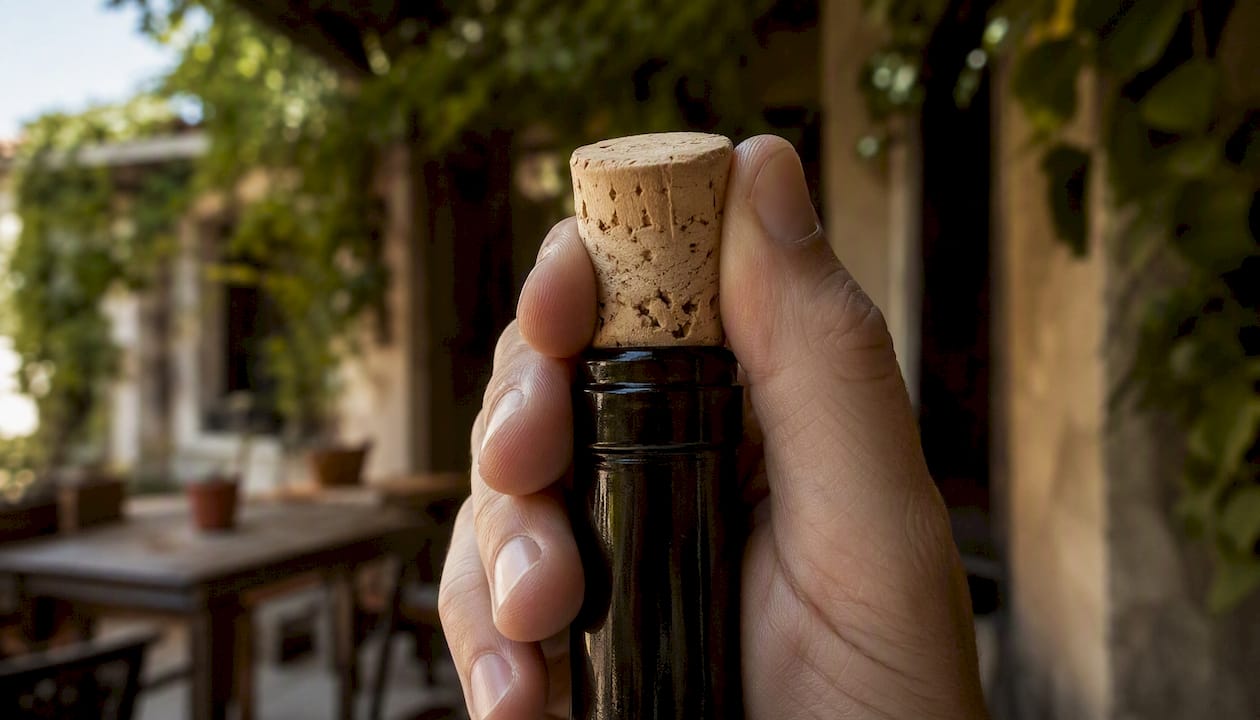
Cork is the only closure that combines genuine breathability, a renewable supply chain, and a track record measured in centuries. The micro-oxygenation it provides isn’t a flaw to be engineered away — for wines built to age, it’s the mechanism. A great Barolo or Napa Cabernet sealed under a screw cap will age, but it will age differently, and most serious collectors still prefer cork for that reason.
The sustainability argument has also grown stronger. Cork forests are among the most biodiverse ecosystems in Europe, and the harvest cycle actively benefits the trees. That’s a genuinely rare story in commercial agriculture.
For everyday wine lovers, the practical takeaway is simple: the closure on your bottle was chosen deliberately. Understanding why helps you store wine correctly, recognize faults when they appear, and make smarter choices at the shop. Fine-wine-world’s guide to cellaring and serving aged wine is a good next read if you want to put that knowledge to work.
Ready to go deeper into wine? Fine-wine-world’s complete guide to aging wine covers everything from choosing the right bottles to cellar conditions and when to finally pull that cork. Whether you’re building a collection or just curious about what’s in your rack, it’s the practical companion you need.
Sources
- What is it – Cork – Corticeira Amorim, world’s biggest cork processing group
- Cork: Raw Material and Production Process | Amorim Cork
- Cork structure, properties and applications (Arnold Arboretum / Harvard)
- Cork and cork oak (FAO technical document)
- How cork is made (MadeHow)
- How Is a Cork Stopper Made? From Tree to Bottle – Enosuber