
What Is a Wine Cooperative? A Clear Guide for Wine Lovers
A wine cooperative is an agricultural organization jointly owned and run by grape growers who pool their resources to make, bottle, and sell wine collectively. Known formally as a cave coopérative in French wine regions or a cantina sociale in Italy, these member-owned organizations sit at the heart of global wine production. Wine cooperatives produce over 50% of all wine in major European countries like France, Italy, and Spain. For everyday wine lovers, understanding how cooperatives work reveals a lot about where your wine comes from and why it often delivers outstanding value.
Affiliate Disclosure: Some links on Fine Wine World are affiliate links, meaning we may earn a paid commission if you click through and make a purchase — at no extra cost to you. Affiliate programs use cookies to track commissions, which may collect personal data. You can read more about how we handle your data in our Privacy Policy and Affiliate Disclosure. We only recommend products we genuinely trust.
What is a wine cooperative and how does it work?
A wine cooperative is a business structure where grape growers become members by contributing their harvest to a shared facility. The cooperative handles winemaking, bottling, and sales on behalf of all members. No single grower owns the winery outright. Every member has an equal stake in the organization’s success.
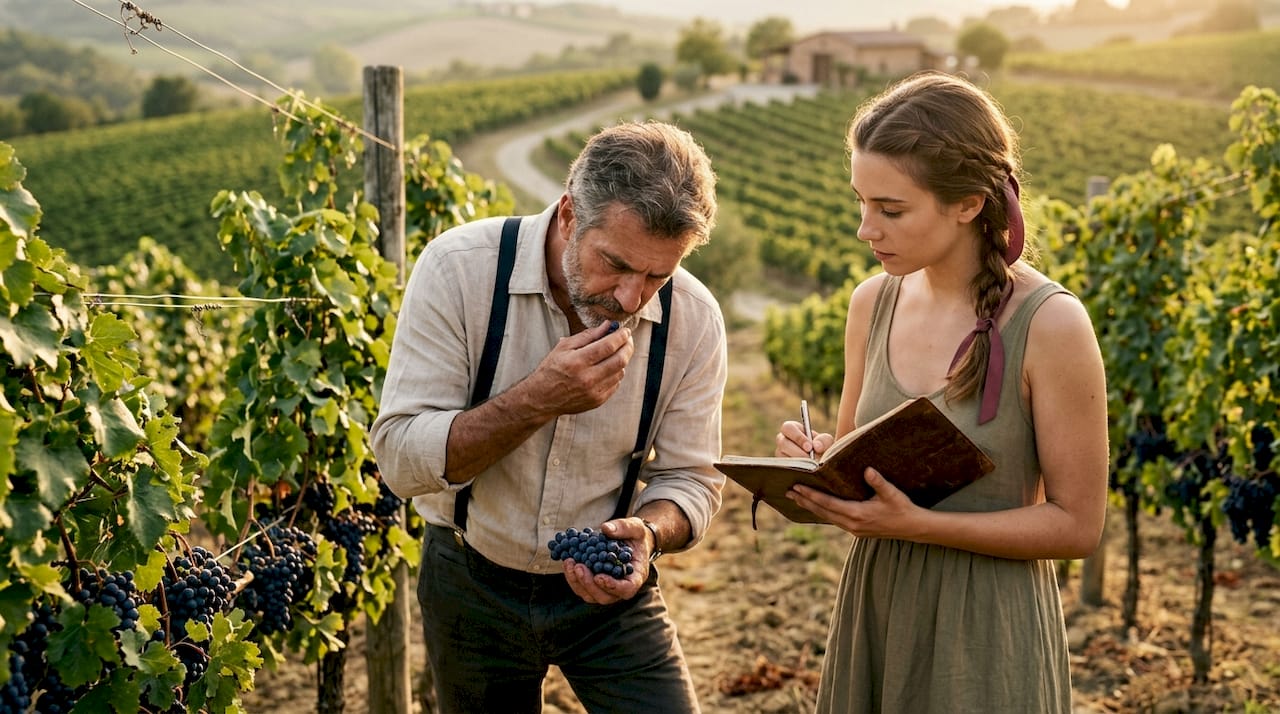
The governance model is the defining feature. Cooperatives operate under a one-member, one-vote system that protects small growers and ensures democratic decision-making. A grower with two acres gets the same vote as a grower with two hundred acres. That equality is rare in the wine industry and sets cooperatives apart from corporate-owned wineries.
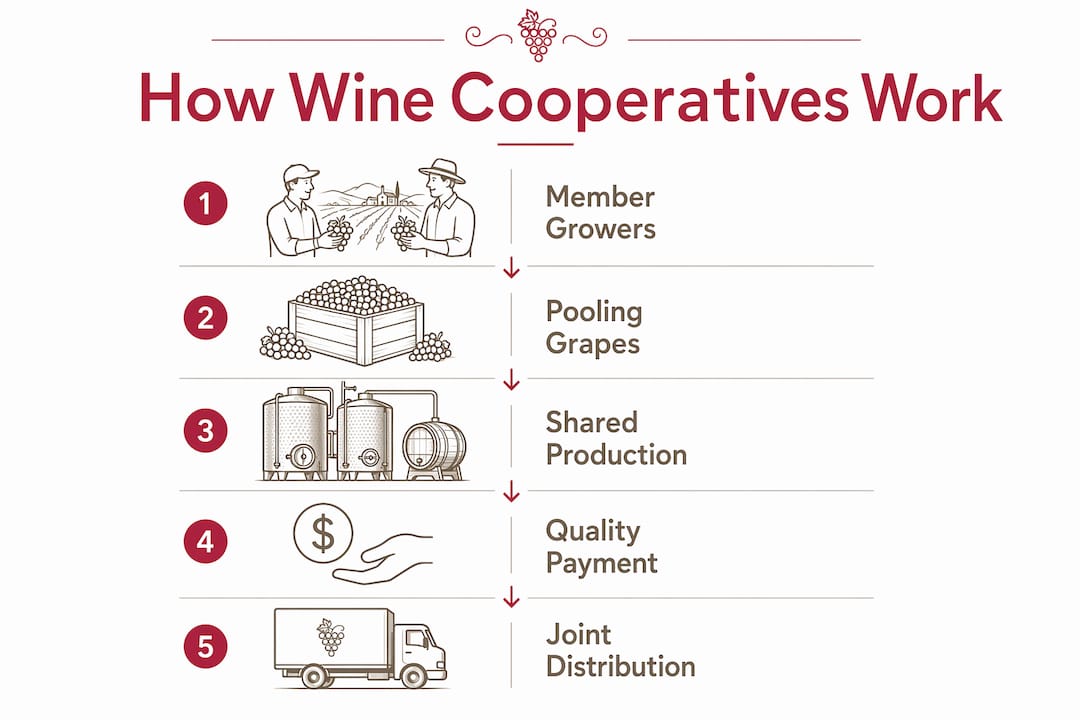
Here is how the core process works in practice:
- Grape delivery: Members bring their harvested grapes to the cooperative’s shared facility each season.
- Pooled production: The cooperative’s winemaking team blends, ferments, and ages the wine using shared equipment.
- Quality-indexed payment: Members are compensated based on grape quality, not just volume, which rewards better vineyard management.
- Profit distribution: Surplus profits flow back to members after operating costs, usually in proportion to their contribution.
- Collective marketing: The cooperative sells wine under a shared label, giving small growers access to markets they could not reach alone.
Pro Tip: When you buy a bottle labeled “cave coopérative” or “cantina sociale,” you are supporting dozens of small family farms, not a single corporate estate.
The quality-indexed payment system deserves special attention. It means growers earn more for delivering healthier, more carefully tended grapes. That financial incentive pushes members toward better farming practices, including organic and low-intervention viticulture.
What are the benefits of joining a wine cooperative?
The advantages of wine cooperatives fall into three clear categories: economic, social, and environmental. Each one matters for small growers who would otherwise struggle to survive in a competitive global market.
Economic advantages
- Shared infrastructure costs: Capital costs for launching an independent winery often exceed $500,000 even at modest production scales. Cooperative membership gives growers access to that same equipment for a fraction of the price.
- Stronger bargaining power: A cooperative selling 500,000 bottles negotiates far better prices with distributors and retailers than any single small producer could.
- Reduced financial risk: Market downturns and bad harvests hit individual producers hard. Shared resources spread that risk across the entire membership.
- Access to export markets: Small growers rarely have the logistics or marketing budgets to sell internationally. Cooperatives open those doors.
Social and cultural advantages
- Preservation of family farms: Cooperatives act as social structures that allow small family farms to preserve heritage while accessing modern winemaking technology they could not afford individually.
- Rural community stability: When small farms stay viable, rural towns stay alive. Cooperatives anchor local economies in wine regions across Europe and beyond.
Pro Tip: If you want to find great value wines that also support small farming families, look for bottles from well-known cooperative regions like Languedoc, the Rhône Valley, or Piedmont.
The social dimension is often underestimated. The cooperative business model builds social cohesion among small-scale wine farmers, securing local traditions that would otherwise disappear under pressure from large commercial producers. That is not a soft benefit. It is the reason entire wine cultures in southern France and rural Italy have survived for generations.
Where do wine cooperatives have the biggest impact?
Europe is the undisputed center of cooperative wine production. Cooperatives produce more than half the wine volume in France, Italy, and Spain, with some regions reaching even higher concentrations. In Languedoc alone, cooperatives account for up to two-thirds of total production. That scale is hard to overstate.
The Rhône Valley offers a striking example. One in every six bottles sold from the Rhône is produced by a cooperative, and those same cooperatives lead the region’s environmental sustainability programs. Production volume and environmental leadership go hand in hand there.
| Region | Cooperative role | Notable example |
|---|---|---|
| Languedoc, France | Up to two-thirds of regional production | Multiple large cave coopératives |
| Rhône Valley, France | One in six bottles; sustainability leaders | Rhône cooperative network |
| Piedmont, Italy | Premium Nebbiolo production | Produttori del Barbaresco (est. 1958) |
| South Africa | Foundational cooperative history | KWV (est. 1918) |
| New York, USA | Emerging cooperative and collective models | New York Wine Authority members |
Produttori del Barbaresco, established in 1958 in Italy, is the clearest proof that cooperatives can produce world-class wine. Its Barbaresco DOCG wines compete with the finest single-estate bottles in Piedmont. KWV in South Africa, founded in 1918, shaped the country’s entire wine industry for decades. Both examples show that cooperatives are not just about volume. They can define a region’s identity and quality ceiling.
The shift from bulk production to premium focus is the most important trend in cooperative wine today. Cooperatives that once sold anonymous table wine by the tanker now bottle single-vineyard expressions and pursue organic certification. That evolution reflects both market demand and the quality-indexed payment systems pushing members to improve their vineyards.
How do cooperatives lead on sustainability?
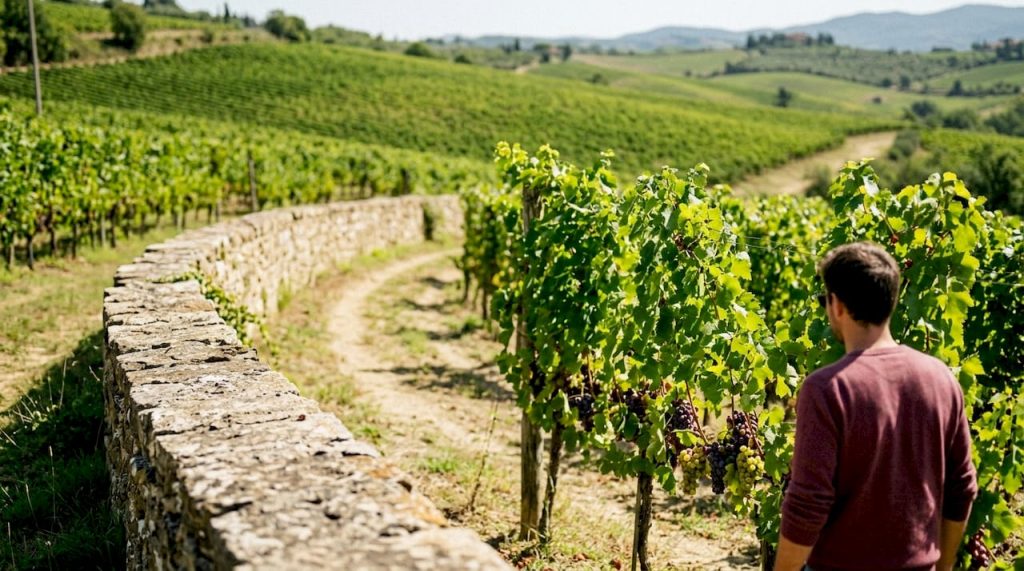
Cooperatives hold a structural advantage in sustainability. Because they pool resources, they can fund environmental programs that no individual small grower could afford alone. Cooperatives lead collective environmental projects including reduced herbicide use, biodiversity promotion, and organic certification efforts.
The collective approach accelerates change in ways that individual action cannot. Key sustainability initiatives common across cooperative networks include:
- Organic and biodynamic conversion: Cooperatives fund the transition costs and provide shared expertise, making organic and biodynamic farming accessible to members who could not afford it independently.
- Pesticide and herbicide reduction: Group programs set targets and monitor progress across all member vineyards simultaneously.
- Biodiversity projects: Cooperatives plant cover crops, maintain hedgerows, and restore natural habitats at a scale that creates measurable ecological impact.
- Water management: Shared irrigation infrastructure and monitoring systems reduce water use across entire growing areas.
- Carbon tracking: Larger cooperatives now measure and report collective carbon footprints, a practice rare among small independent producers.
Pooling resources and expertise provides greater resilience to climate and market volatility than solo operations. That resilience is becoming more valuable every year as growing seasons grow less predictable. A cooperative with 200 member vineyards can absorb a localized frost or drought far better than any single estate.
What is the difference between a wine cooperative and a winery?
The distinction matters more than most wine drinkers realize. A cooperative and an independent winery may both produce excellent wine, but they operate on completely different principles.
An independent winery is owned by one person, a family, or a corporation. Profit flows to the owner. Decisions are made by management. The winery buys grapes or grows its own, and the brand reflects a single vision.
A wine cooperative is owned collectively by its grower members. Formal cooperatives combine joint production and democratic governance, which the New York Wine Authority distinguishes clearly from marketing collectives, where producers share a brand but remain independent operations. That distinction matters for understanding who controls quality, pricing, and direction.
Here is how the key differences break down:
| Feature | Wine cooperative | Independent winery |
|---|---|---|
| Ownership | Member growers collectively | Single owner, family, or corporation |
| Governance | One member, one vote | Owner or management decides |
| Profit distribution | Returns to members | Goes to owner or shareholders |
| Capital requirement | Shared across members | Borne entirely by owner |
| Brand identity | Collective label | Single estate or brand |
| Quality control | Collective standards and incentives | Owner’s personal standards |
Marketing collectives occupy a middle ground. Members keep their own vineyards and production but collaborate on sales and branding. They are not true cooperatives because they lack the shared production facility and democratic governance structure. The difference matters when you are evaluating a wine’s provenance and the producer’s actual relationship to the land.
For wine lovers, the practical implication is this: a cooperative wine represents the collective effort of many families. An estate wine represents one producer’s vision. Neither is inherently better, but they tell very different stories.
Key Takeaways
Wine cooperatives are member-owned organizations that pool grapes, share winemaking infrastructure, and distribute profits democratically, making them the backbone of wine production across France, Italy, Spain, and beyond.
| Point | Details |
|---|---|
| Democratic ownership | Every member gets one vote regardless of vineyard size, protecting small growers. |
| Major production share | Cooperatives produce over 50% of wine in France, Italy, and Spain. |
| Cost savings for growers | Shared infrastructure removes the need for $500,000+ in individual startup costs. |
| Sustainability leadership | Cooperatives fund collective organic, biodiversity, and pesticide-reduction programs. |
| Distinct from independents | Cooperatives differ from wineries and marketing collectives in ownership, governance, and profit structure. |
Why cooperatives deserve more credit than they get
By Adriana
Cooperatives get dismissed too often. The assumption is that shared production means diluted quality, anonymous blends, and wines made for volume rather than pleasure. That assumption is wrong, and Produttori del Barbaresco proves it every single vintage.
What strikes me most about the cooperative model is how well it solves a problem that the wine industry rarely talks about openly: the brutal economics of small-scale farming. Growing grapes beautifully is one skill. Bottling, marketing, and distributing wine profitably is an entirely different business. Most small growers are excellent at the first and completely exposed on the second. Cooperatives close that gap.
I also think cooperatives are underrated as a climate response. When a single grower converts to organic farming, it affects a few acres. When a cooperative converts, it affects thousands of acres simultaneously. That collective scale is the only way the wine industry will meet the environmental challenges of the next few decades.
My honest advice: next time you see a cooperative wine on a shelf, pick it up. You are likely getting a wine that represents real community, real history, and increasingly, real quality.
— Adriana
Fine-wine-world has more to help you explore
If wine cooperatives have sparked your curiosity about where wine actually comes from, you are ready to go deeper. Fine-wine-world covers the full picture, from the regions where cooperatives dominate to the sustainability practices shaping the industry’s future.

Start with the wine regions beginner’s guide to place cooperatives in their geographic and cultural context. From Languedoc to Piedmont, understanding the regions helps you appreciate why the cooperative model took root where it did. Fine-wine-world also covers sustainable wine production in depth, so you can connect the environmental work cooperatives do to the bottles you choose. Whether you are buying your first cooperative wine or building a collection, Fine-wine-world gives you the knowledge to choose with confidence.
FAQ
What is a wine cooperative in simple terms?
A wine cooperative is a group of grape growers who jointly own a winery, pool their harvests, and share the costs and profits of making and selling wine together.
How do wine cooperatives pay their members?
Most modern cooperatives pay members based on grape quality rather than volume alone. This quality-indexed system rewards growers who invest in better vineyard management and sustainable farming.
Are cooperative wines lower quality than estate wines?
Not necessarily. Produttori del Barbaresco, established in 1958, produces Barbaresco DOCG wines that rank among Italy’s finest. Quality depends on the cooperative’s standards and payment incentives, not the model itself.
What is the difference between a cooperative and a marketing collective?
A formal cooperative shares production facilities and operates under democratic governance. A marketing collective lets independent producers share a brand while keeping separate production. The New York Wine Authority defines this distinction clearly.
Why do cooperatives dominate wine production in Europe?
Cooperatives solve the economic problem of small-scale farming by sharing infrastructure costs that would otherwise be unaffordable for individual growers. In regions like Languedoc, that model has been the foundation of wine production for over a century.