
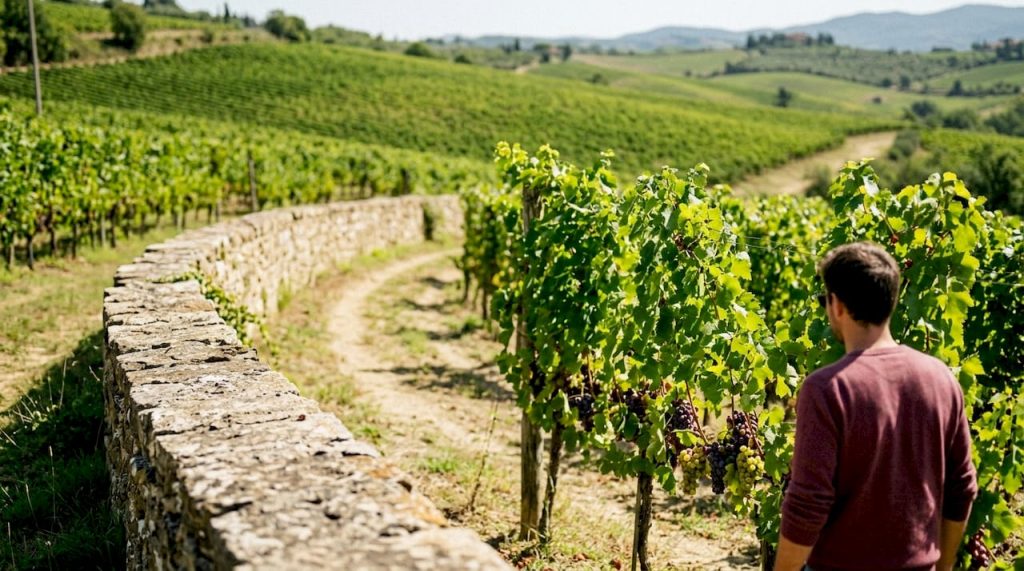
What is a wine region, and why does it matter?
A wine region is defined by the combination of geography and recognition, either through law or long tradition. The term most wine professionals use is appellation, which refers to the named, regulated area where a wine’s grapes are grown. Knowing the appellation on a label tells you far more than the grape variety alone. It tells you the climate, the soil type, and the general style you can expect in the glass.
The practical value is real. When you see “Burgundy” on a label, you know the wine comes from a cool continental climate in eastern France, almost certainly made from Pinot Noir or Chardonnay, and produced under strict rules about yields and winemaking. That single word carries a world of information. For wine lovers at any level, reading a label with that kind of confidence changes the entire experience of buying and drinking wine.
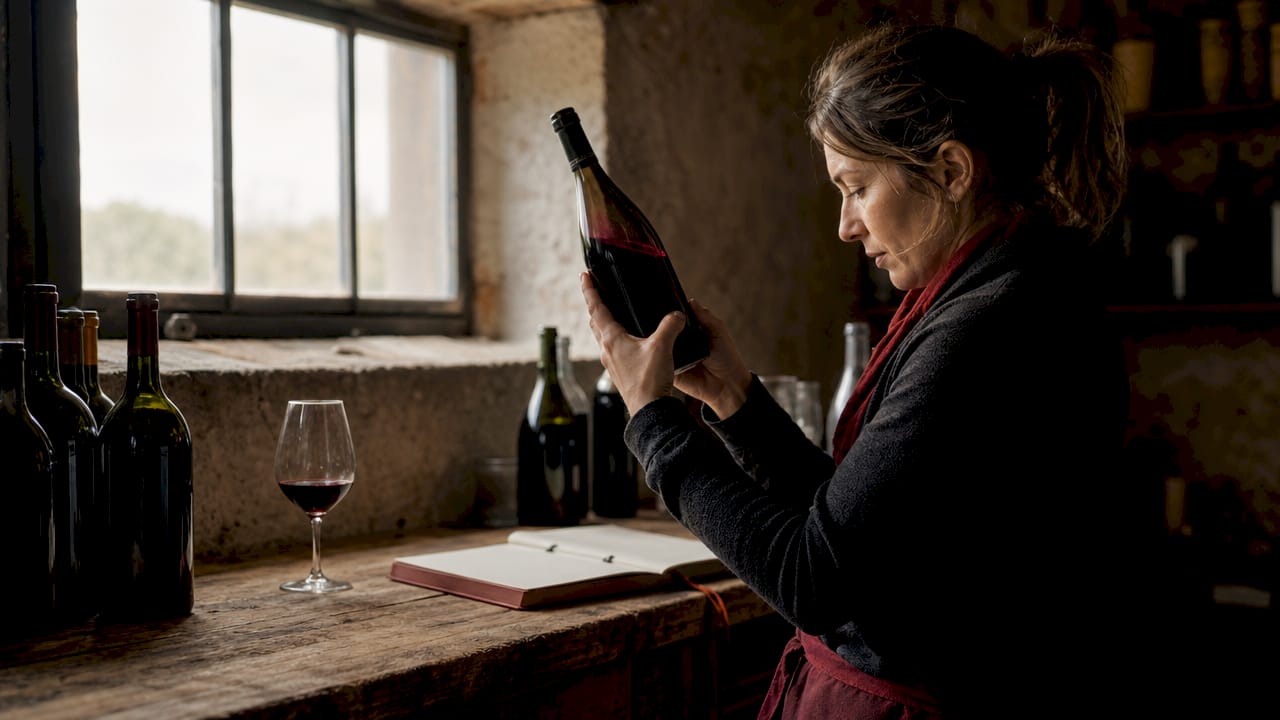
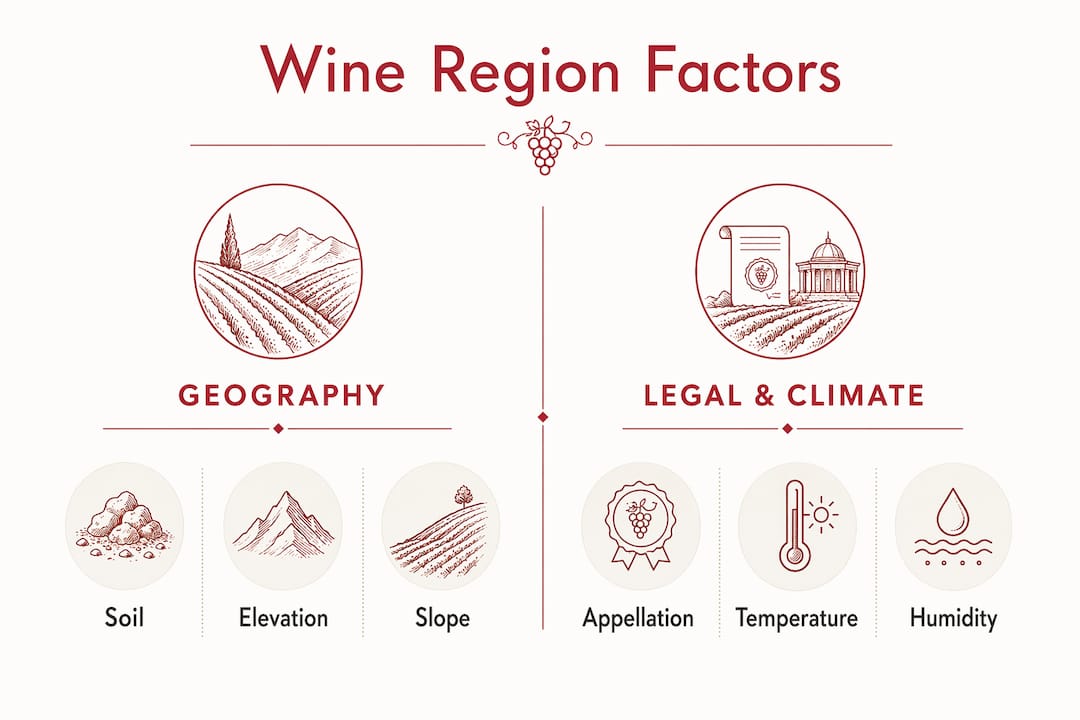
Terroir is the term that ties all of this together. It encompasses measurable environmental factors including soil type, slope, elevation, microclimate, and drainage that collectively shape a vineyard’s unique wine character. Terroir is not a mystical idea. It is a scientifically grounded set of conditions that produce real, detectable differences in flavor and structure.
What geographical and climatic factors define wine regions worldwide?
Geography is the starting point for every wine region on earth. Most established wine regions fall between 30° and 50° latitude in both hemispheres, a zone commonly called the wine belt. Within that band, temperatures are warm enough to ripen grapes but cool enough to preserve the acidity that gives wine its structure and freshness.
Climate type matters enormously within that belt. The three main climate categories for wine regions are:
- Mediterranean climates (warm, dry summers and mild winters): ideal for Cabernet Sauvignon, Grenache, and Syrah. Examples include Bordeaux, Napa Valley, and the Barossa Valley.
- Continental climates (hot summers and cold winters with low humidity): produce wines with strong seasonal character. Burgundy and Rioja fall here.
- Maritime climates (moderated by ocean influence, with consistent rainfall): favor aromatic whites and lighter reds. Germany’s Mosel and New Zealand’s Marlborough are strong examples.
Soil composition adds another layer of complexity. Limestone soils in Burgundy contribute to the mineral quality of Chardonnay. The volcanic basalt of Oregon’s Willamette Valley gives Pinot Noir a distinctive earthy depth. Clay retains water and favors Merlot, which is why the right bank of Bordeaux, dominated by clay, produces the grape so well.
Elevation and slope also shape wine character. Higher altitudes mean cooler nights, which slows ripening and builds aromatic complexity. Diurnal temperature variation, the gap between daytime heat and nighttime cold, is especially critical in warm regions. Mendoza, Argentina sits at high altitude in the Andes foothills, and that daily temperature swing is the reason its Malbec retains freshness despite the intense summer sun.
Pro Tip: When you pick up a bottle, check the region before the grape variety. The region tells you the climate, and the climate tells you the style. That shortcut works across almost every wine-producing country.
How do legal frameworks and appellation systems shape wine regions?
Wine regions are not just geographic facts. They are legal constructs, and the rules vary significantly between the Old World and the New World. The European Union’s framework under Regulation No 1308/2013 establishes two main categories: Protected Designation of Origin (PDO) and Protected Geographical Indication (PGI). This system has been the primary legal structure since 2009 and ties wine identity directly to its geographic source.
Old World appellation systems go further than just drawing boundaries. France’s Appellation d’Origine Contrôlée (AOC) system, Italy’s DOC and DOCG designations, and Spain’s Denominación de Origen (DO) all regulate permitted grape varieties, maximum yields per hectare, and specific winemaking methods. A Chianti Classico DOCG, for example, must contain at least 80% Sangiovese and meet minimum aging requirements. These rules exist to protect regional identity and give consumers a reliable quality signal.
The US AVA system takes a different approach. American Viticultural Areas define geographic boundaries but do not regulate grape varieties or winemaking processes. A winemaker in Napa Valley can legally grow any grape and make wine any way they choose, as long as 85% of the grapes come from within the AVA. That flexibility encourages experimentation but also means the AVA name alone carries less quality assurance than a European PDO.
| Feature | European PDO/AOC/DOC | US AVA |
|---|---|---|
| Geographic boundary | Yes, strictly defined | Yes, strictly defined |
| Permitted grape varieties | Regulated | Not regulated |
| Winemaking methods | Regulated | Not regulated |
| Minimum yields | Regulated | Not regulated |
| Quality tier system | Yes (e.g., DOCG above DOC) | No formal tier |
Label terms also carry weight. “Estate-bottled” wines require full winery control over all phases of grape growing and winemaking within the same viticultural area. “Estate-grown” implies less oversight. When you see “estate-bottled” on a US label, it signals a higher standard of production accountability.
Pro Tip: In Europe, a stricter appellation generally means a more predictable style. In the US, a prestigious AVA like Napa Valley signals quality through reputation rather than regulation. Know which system you are reading before you judge the label.
What are some of the world’s most influential wine regions?
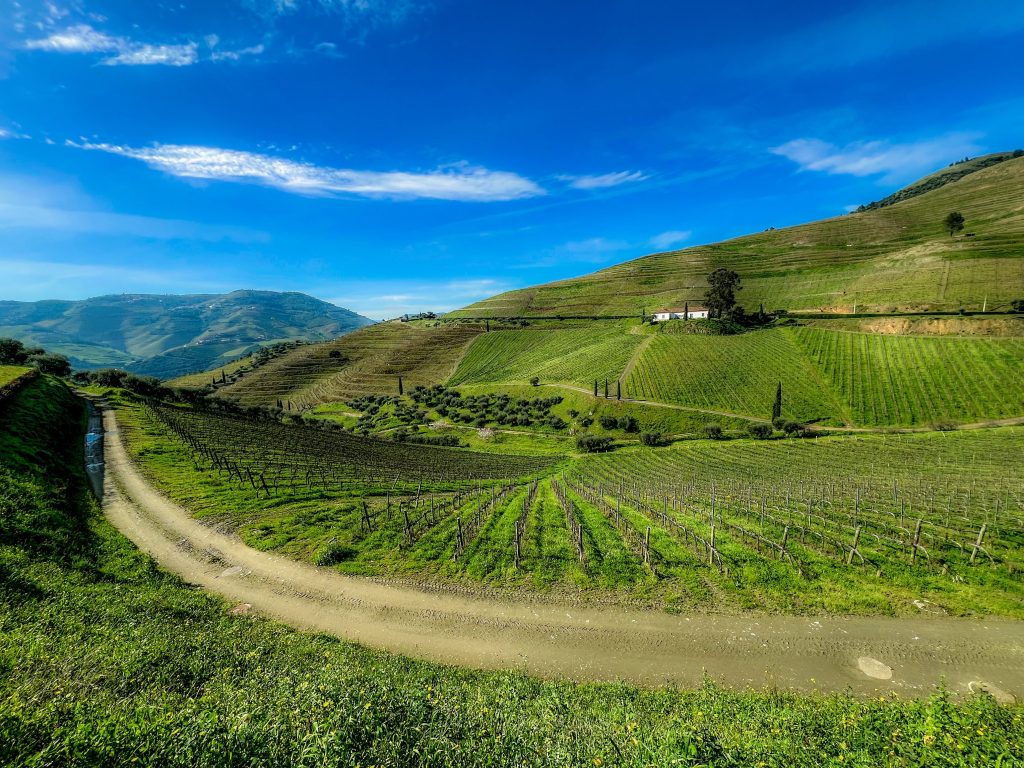
The world’s key wine regions each carry signature grape varieties and styles shaped by terroir and centuries of practice. Getting familiar with a handful of them gives you a working map of global wine diversity.
Old World regions to know:
- Bordeaux, France: The home of Cabernet Sauvignon and Merlot blends. The left bank (Médoc) favors Cabernet; the right bank (Saint-Émilion, Pomerol) favors Merlot. Bordeaux’s maritime climate produces structured, age-worthy reds.
- Burgundy, France: Pinot Noir and Chardonnay territory, with a continental climate and limestone-rich soils. Burgundy’s appellation system is the most granular in the world, with individual vineyard plots (called crus) carrying their own legal status.
- Tuscany, Italy: Sangiovese is the dominant grape, appearing in Chianti Classico, Brunello di Montalcino, and Vino Nobile di Montepulciano. The warm Mediterranean climate produces wines with firm tannins and bright acidity.
- Rioja, Spain: Tempranillo is king here, often blended with Garnacha. Rioja’s continental climate and oak-aging traditions produce wines ranging from fresh and fruity to deeply complex.
New World regions worth knowing:
- Napa Valley, California: The benchmark for American Cabernet Sauvignon. A warm Mediterranean climate and significant winemaking investment have made Napa one of the most recognized wine names globally.
- Willamette Valley, Oregon: Oregon’s answer to Burgundy. A cool, wet maritime climate produces Pinot Noir with earthy depth and restrained fruit, often compared favorably to French examples.
- Mendoza, Argentina: High-altitude Malbec country. The Andes foothills provide elevation and diurnal variation that give Mendoza Malbec its signature balance of richness and freshness.
- Barossa Valley, Australia: Known for old-vine Shiraz with concentrated fruit and full body. The warm Mediterranean climate and some of the world’s oldest Grenache and Shiraz vines make Barossa a region unlike any other.
Emerging regions are also worth watching. Georgia (the country) is gaining global attention for its ancient amber wine tradition using the qvevri clay vessel method. Portugal’s Douro Valley, long known for Port, now produces exceptional dry reds. Uruguay’s Tannat and South Africa’s Swartland are two more names appearing more frequently on serious wine lists.
How does knowing wine regions improve your wine experience?
Region knowledge gives you a reliable shortcut to flavor prediction. A wine from a cool climate region like Burgundy or Mosel will almost always show higher acidity, lower alcohol, and more delicate fruit than one from a warm region like Barossa or Napa. You do not need to memorize every producer. You just need to know the climate type.
Pairing food with wine also becomes much easier once you think by region. Italian regional wines are built to go with Italian food. Chianti Classico’s acidity cuts through tomato-based pasta sauces. A crisp Muscadet from the Loire Valley pairs naturally with oysters because both come from the same coastal environment. Fine-wine-world’s guide to food and wine pairing walks through these regional connections in practical detail.
A few common misconceptions are worth clearing up:
- A prestigious region does not guarantee a great bottle. Bordeaux and Burgundy produce wines at every quality level, from everyday drinking to collector-grade. The appellation sets the rules; the producer determines the quality.
- New World does not mean lower quality. Napa Valley Cabernet and Willamette Valley Pinot Noir regularly outperform European counterparts at blind tastings.
- A larger appellation is not automatically worse. Some broad regional appellations, like Côtes du Rhône in France, offer outstanding value because producers within them are not constrained by the most restrictive rules.
The best way to build region knowledge is to drink deliberately. Pick one region per month, buy two or three bottles from different producers, and compare them. You will learn more from that exercise than from reading any single guide. Fine-wine-world’s beginner’s map of wine regions is a good companion for that kind of structured tasting.
Key Takeaways
A wine region is defined by geography, climate, and legal recognition, and understanding those three factors is the fastest way to read any wine label with confidence.
| Point | Details |
|---|---|
| Wine region definition | A geographically delimited area producing wines with distinct characteristics tied to location. |
| The wine belt | Most world wine regions fall between 30° and 50° latitude, where climate balances ripening and acidity. |
| Old World vs. New World rules | European appellations regulate grapes and methods; US AVAs define only geographic boundaries. |
| Terroir is measurable | Soil, slope, elevation, and diurnal variation are concrete, detectable factors, not abstract concepts. |
| Region knowledge aids selection | Knowing a region’s climate type reliably predicts a wine’s style, acidity, and food pairing potential. |
Why wine regions matter more than most people realize

I grew up around a family vineyard, and the thing that struck me earliest was how much the same grape could taste completely different depending on where it was grown. That observation, which felt almost obvious at the time, turns out to be the entire foundation of how the wine world is organized.
What I have noticed over years of tasting is that people tend to fixate on grape varieties and ignore regions entirely. They find a Pinot Noir they love and then buy every Pinot Noir they can find, wondering why some disappoint. The answer is almost always geography. A Pinot Noir from Willamette Valley and one from Barossa Valley are not the same wine in different packaging. They are fundamentally different expressions of the same grape, shaped by entirely different climates and soils.
The regulation debate is also more nuanced than it first appears. European appellation rules can feel restrictive, but they exist because centuries of trial and error proved that certain grapes thrive in certain places. When Burgundy says only Pinot Noir and Chardonnay are permitted, that is not arbitrary gatekeeping. It is the accumulated knowledge of generations of growers encoded into law. New World flexibility is genuinely exciting, but it also means the consumer carries more of the burden of research.
My honest advice is to let regions guide your buying before you let producers or critics do it. Once you understand that a cool maritime climate produces a certain kind of wine and a warm Mediterranean climate produces another, you have a mental framework that works across every country and every grape. That framework is worth more than any score or recommendation.
— Adriana
Ready to go deeper into wine regions?
Fine-wine-world has put together a full beginner’s guide to wine regions that covers the major producing areas around the world with maps, regional profiles, and tasting notes written for everyday wine lovers.
Whether you want to understand what makes Burgundy different from Bordeaux or you are curious about emerging regions like Georgia or Uruguay, the guide gives you the context to make sense of what is in your glass. Fine-wine-world also covers food and wine pairing by region, so you can take your region knowledge straight to the dinner table. No expertise required. Just curiosity and a corkscrew.
FAQ
What is the wine region definition in simple terms?
A wine region is a specific geographic area, recognized by law or tradition, where grapes are grown and wines are produced with characteristics tied to that location’s climate, soil, and terrain.
How are wine regions officially classified?
In Europe, wine regions are classified under the EU’s PDO and PGI system established by Regulation No 1308/2013. In the United States, the TTB approves American Viticultural Areas based on geographic boundaries alone.
What is a wine estate, and how does it relate to a region?
A wine estate is a property where grapes are grown and wine is produced, typically within a single recognized wine region. An “estate-bottled” label means the winery controlled every step from growing to bottling within one viticultural area.
What defines a wine region’s character?
Terroir defines a wine region’s character. That includes soil type, elevation, slope, drainage, and climate, particularly the diurnal temperature variation between day and night, which shapes acidity and aromatic complexity.
Which wine regions are best for beginners to start with?
Bordeaux, Burgundy, Napa Valley, and Rioja are the most practical starting points. Each region has a clear signature grape variety and style, making them easy to recognize and compare as you build your palate.